In most U.S. states, cannabis topicals have no strict THC mg cap like edibles, though some states regulate by weight or category.
Non-transdermal topicals can contain hundreds to thousands of mg THC without causing a high, making them safe for localized relief when used as directed.
Here’s how THC topicals may differ for you:
- Chronic pain sufferers: May need 500-2000mg+ for deeper, longer relief.
- Seniors: Non-psychoactive high-THC topicals for daytime function.
- CBD users: A THC-forward blend can deliver where CBD alone fell short.
- Newcomers: True topicals won’t get you high, transdermals or ingestion might.
- Researchers: Potency limits vary, some states regulate by product weight, others not at all.
If you want to know the maximum legal amount, whether THC can be applied topically, or if 100mg is a lot, this guide will walk you through the science, the laws, and how to choose a product that actually works.
Sweet Releaf specializes in high-THC, whole-plant topicals designed to give you real relief, without the high, so you can get back to doing what you love.
If you’re ready for the full breakdown, keep reading.
The Quick Answer (and the Details You Need to Know)
When it comes to cannabis laws in the U.S., edibles are heavily restricted, typically capped at 5-10mg THC per serving and 100mg per package.
Topicals, however, are often a different story. In many states, there is no hard limit on how much THC a topical can contain, and it’s common to see jars with 500mg, 1000mg, or even 2000mg+ THC.
That said, there are exceptions. Some states regulate by total weight percentage instead of milligrams, think rules like “no more than 6% THC by weight.”
This approach can still produce a high-potency topical but sets an upper boundary based on the size and composition of the product.
The reason for this difference comes down to how topicals interact with your body.
Unlike edibles, inhalables, or tinctures, which send THC into your bloodstream and potentially to your brain, true topicals work locally.
They target cannabinoid receptors in your skin and underlying tissue without crossing the blood-brain barrier. That means no psychoactive “high” and no risk of impairment for most people.
And here’s some peace of mind: standard non-transdermal topicals won’t cause you to fail a drug test when used as intended.
The exception is transdermal products, specifically formulated to pass cannabinoids into your bloodstream, or mislabeled products that are actually meant to be ingested.
Choosing a reputable brand with transparent labeling is the safest way to know exactly what you’re using.
Understanding THC in Topicals, Science & Safety
THC’s relationship with your skin is all about local action. Your skin and fascia are rich in CB2 receptors, part of the body’s endocannabinoid system (ECS).
When THC binds to these receptors, it can help reduce inflammation, calm overactive nerve signals, and ease muscle tension, all without entering your bloodstream.
This is why non-transdermal topicals don’t cause a high: the cannabinoids stay in the skin’s lipid layers and never cross the blood-brain barrier.
On the market today, THC topical potency varies widely.
You’ll find modest 100mg jars, often aimed at casual users or mild discomfort, and mid-range 500-1000mg formulas for more persistent pain.
At the high end, 2000mg+ jars are designed for people with severe or chronic conditions who need longer-lasting, deeper relief.
The right potency depends on your symptoms, frequency of use, and how your body responds.
Absorption is not only about milligrams but also about the base formula.
- Emulsions (like Sweet Releaf’s aloe-based body butters) tend to penetrate more quickly and evenly into the skin than waxy salves.
- Carrier oils (coconut, jojoba, shea butter) affect how lipophilic THC moves into lipid-rich layers.
- Co-ingredients such as aloe vera, menthol, or warming botanicals can enhance penetration or add sensory relief.
One thing to watch out for: accidental intoxication from mislabeled products. Some ingestible cannabis oils are marketed as “topicals” to bypass edible THC caps in certain states.
If eaten, these can absolutely cause a high, sometimes an intense one.
To avoid this, always read the label for intended use and look for reputable, transparent brands that clearly distinguish between topical, transdermal, and edible products.
Helpful Resources => Do THC Topicals Really Work? Pain Relief Explained
Legal Limits Across States
Cannabis topicals live in a regulatory gray zone, and the rules can vary dramatically depending on where you are.
In California, Colorado, and Washington, there’s no THC cap for topicals, meaning products can legally contain 2000mg or more THC per jar without breaking any potency laws.
This freedom allows for high-strength formulas designed for chronic pain or post-surgery recovery.
Other states take a percentage-based approach, limiting THC concentration by total product weight.
For example, a rule like “no more than 6% THC by weight” means a larger jar can contain more THC than a smaller one, even at the same concentration.
In some regions, laws differ by category. Medical cannabis programs may allow significantly higher-potency topicals than adult-use markets.
That’s why you might see the same brand selling a 1000mg jar to medical card holders but only a 500mg version for recreational shoppers.
A standout example comes from Washington: while edibles are capped at 10mg THC per serving and 100mg per package, there’s no such limit for topicals.
This loophole has led some brands to market ingestible oils as “topicals” to sidestep edible caps, a practice that causes consumer confusion and raises safety concerns if those products are consumed.
If you’re wondering which states regulate by weight vs. mg THC, the answer changes often as cannabis laws evolve.
Always check your state’s most recent cannabis control board or health department guidelines before purchasing or traveling with high-THC topicals.
Is 100mg of THC a Lot in a Topical?
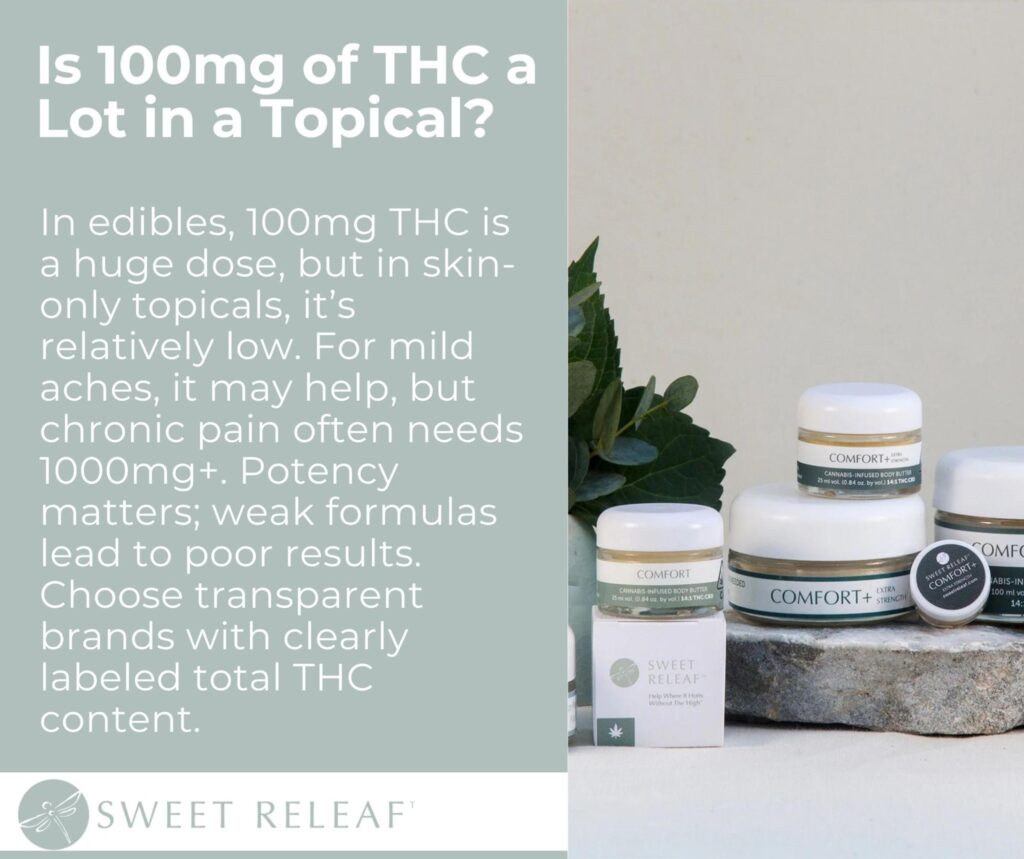
In the world of edibles, 100mg of THC is a huge dose, enough to overwhelm most casual users if ingested.
But in the world of true, skin-only topicals, 100mg spread across an entire jar or bottle is relatively low.
When applied topically, cannabinoids stay in the skin and fascia, so you need a much higher concentration to achieve noticeable results.
For mild, surface-level discomfort, a 100mg topical might offer some relief, especially if paired with other soothing ingredients like menthol or arnica.
But for chronic pain, deep joint aches, or post-surgery recovery, such a low dose often is not enough.
That’s why many people turn to high-potency formulas like Sweet Releaf Comfort+, which contains over 1000mg THC per jar.
This level of concentration allows for a more pronounced and longer-lasting effect without psychoactive side effects.
The real worry here is buying weak formulas that don’t work. Too often, customers try a low-THC topical, feel little to no relief, and conclude that cannabis topicals “just don’t work.”
The truth is, potency matters, and under-dosing is one of the most common reasons people give up on topicals prematurely.
Reading labels carefully and choosing a brand that’s transparent about both total cannabinoid content and per-use potency is the best way to avoid this disappointment.
Does Topical THC Get You High?
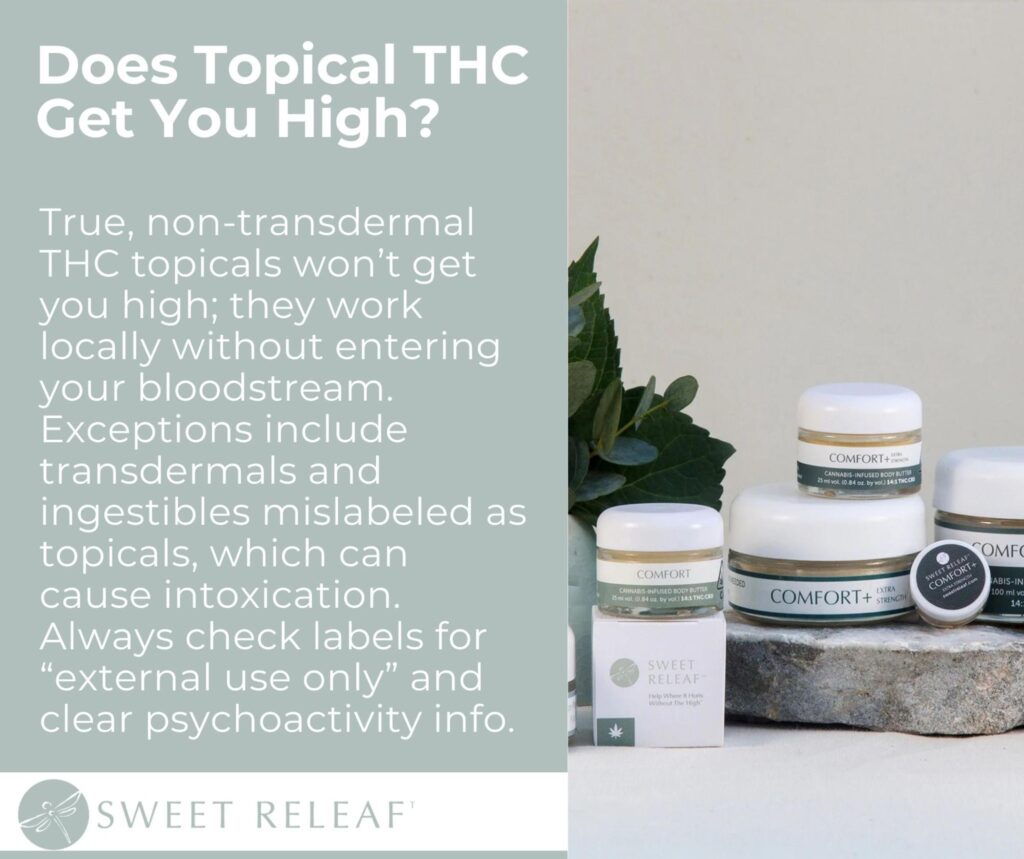
The short answer: no, as long as it’s formulated as a true topical.
Non-transdermal cannabis topicals are designed to work locally, binding to cannabinoid receptors in your skin and underlying tissue without entering your bloodstream.
Because they never reach your brain, they cannot produce a psychoactive high.
There are, however, two key exceptions:
- Transdermals – These are engineered to push cannabinoids through the skin barrier and into the bloodstream. They can produce psychoactive effects if they contain enough THC.
- Ingestibles disguised as topicals – Some products are marketed as “topicals” but are actually edible oils or tinctures. If swallowed, they act like edibles and can cause a strong high.
It’s also worth noting the “Euphoria Effect”, that sense of well-being and relief that can come from easing chronic pain or inflammation.
This is not the same as a psychoactive high, but for someone living with constant discomfort, it can feel like a weight being lifted.
How to tell topical vs. transdermal on labels:
- Look for terms like “transdermal patch,” “systemic absorption,” or “designed for bloodstream delivery”, which indicate a transdermal product.
- A true topical will be labeled for external use only, with no dosage-per-serving guidance for oral consumption.
- Transparent brands will clearly state whether their product is psychoactive or not.
Special Considerations for Different Users
Chronic Pain & Post-Surgery Recovery
For people managing persistent pain or healing from surgery, higher milligram THC topicals, often 1000mg or more per jar, can make a significant difference in both speed and duration of relief.
Applying a generous layer directly to the affected area and reapplying every few hours can help maintain comfort.
Some find success with layering applications, starting with a warming formula to increase circulation, followed by a high-THC emulsion for deeper penetration.
Seniors & Sensitive Populations
Many seniors want effective relief without any risk of intoxication or impairment. True THC topicals are ideal here, as they work locally and stay non-psychoactive.
It’s equally important to choose skin-friendly bases, like aloe vera, shea butter, or jojoba oil, especially for aging or sensitive skin that may react to harsh additives.
CBD Users
If CBD creams haven’t delivered the desired relief, adding THC to the mix can change the outcome.
THC interacts with CB2 receptors in ways CBD alone cannot, and when combined, the two can create an entourage effect, enhancing each other’s anti-inflammatory and analgesic properties.
Newcomers
If you’re new to cannabis topicals, start with lower mg per application and patch-test on a small area first.
This helps rule out skin sensitivities to ingredients like menthol, camphor, or essential oils. Once comfortable, you can adjust both potency and frequency to suit your needs.
Medical/Legal Researchers
Regulations evolve quickly, and potency allowances can shift depending on whether a product is categorized as medical or adult-use.
Researchers should keep up with their state’s cannabis control board updates, and note that lab testing standards for topicals may differ from those for edibles or inhalables.
Risks & Misconceptions
Drug Test Realities
A true, non-transdermal THC topical will not show up on a standard drug test, because the cannabinoids never reach your bloodstream.
The exception is transdermal products or accidental ingestion of a mislabeled product, both of which can deliver THC systemically and potentially trigger a positive result.
Allergic Reactions & Sensitivities
Even the most carefully crafted topical can cause skin irritation if a user is sensitive to certain ingredients.
Essential oils like peppermint, eucalyptus, or clove can be potent skin stimulants.
This is why patch-testing a small area before full application is always recommended, especially for those with sensitive skin or compromised skin barriers.
Labeling Confusion
One of the biggest consumer risks is mislabeling. Some products marketed as “topicals” are actually edible oils or tinctures designed for ingestion.
These often appear in markets with strict edible THC caps, where rebranding them as “topicals” allows companies to bypass potency limits.
Consuming these products can cause unexpected intoxication and impair daily activities.
Legal Risks
If a product is miscategorized or violates state potency limits, you could unknowingly possess something considered illegal under local law.
This is particularly important when traveling between states with different regulations.
Always check your state’s cannabis rules and buy from licensed, transparent brands that publish lab results and usage instructions.
Taking Action, Choosing & Using the Right Topical
How to Read a THC Topical Label
Start by looking for the total milligrams of THC in the container, and whether the product also contains CBD or other cannabinoids.
Confirm it’s labeled for external use only and not intended for ingestion, unless you’re specifically buying a transdermal or edible.
Reputable brands will also include a batch number, lab test results, and a full ingredient list so you know exactly what’s in it.
Matching Potency to Condition
- Mild discomfort – 100-300mg THC per jar is often sufficient.
- Moderate to chronic pain – 500-1000mg THC offers deeper, longer-lasting relief.
- Severe or persistent pain – 1000-2000mg+ THC can provide significant support without psychoactive effects when applied topically.
If a lower-potency product has not worked for you, it doesn’t mean topicals won’t work, it often means you only need more THC per application.
Spot vs. Large Area Application
For a specific joint or muscle, a concentrated application in one area is ideal.
For widespread discomfort, like lower back tightness or post-workout soreness, a lighter layer over a larger surface works best. In either case, massage the product in for better skin absorption.
Storage & Shelf-Life Tips
Keep your topical cool, dry, and away from direct sunlight to preserve cannabinoid potency and prevent ingredient separation.
Most high-quality products remain effective for 12-18 months when stored properly. If you notice changes in smell, texture, or color, it may be time to replace it.
Sweet Releaf’s Approach to High-THC Topicals
We’ve built our reputation on formulating THC-forward topicals that deliver maximum pain relief without the high.
Our products maintain a high THC:CBD ratio, ensuring the potent, targeted effect you need for stubborn aches, inflammation, and post-injury recovery, without crossing into psychoactive territory.
Our aloe-based emulsion formulas set us apart from waxy salves or heavy oils.
Emulsions absorb deeper and faster, carrying cannabinoids more efficiently into the skin’s lipid layers for sustained relief. The result? You feel the difference sooner and for longer.
We use whole-plant trichome sourcing, not distillates or isolates, so you get the benefits of a full-spectrum entourage effect.
This means all the cannabinoids, terpenes, and beneficial compounds from the cannabis plant work together to enhance therapeutic impact.
You can choose from:
- Comfort – Balanced relief for everyday aches.
- Comfort+ – Our highest-potency formula, ideal for chronic or deep tissue pain.
- Warms/Cools Roll-Ons – Portable, targeted relief with soothing thermal sensations.
Our customers, ranging from chronic pain survivors and arthritis patients to post-surgery rehabbers, consistently tell us Sweet Releaf topicals helped them get back to gardening, hiking, playing with their grandkids, or simply enjoying a pain-free night’s sleep.
Explore Sweet Releaf’s THC-forward topicals and feel the relief others are talking about.