Cannabis topicals are legal in California for adults 21+ through licensed dispensaries and for medical patients 18+ with a physician recommendation. Federally, marijuana is still illegal, but state-regulated THC creams are lawful within licensed programs.
Untangling Legal Confusion Surrounding Topicals
Cannabis topicals live at the intersection of three legal systems: federal marijuana prohibition, state cannabis legalization, and hemp regulation.
Marijuana remains federally illegal. California operates a fully licensed adult-use and medical cannabis market. Hemp-derived products follow separate federal standards. That overlap creates uncertainty, especially for THC creams that do not produce intoxication.
A non-psychoactive product can still be tightly regulated. A hemp salve sold online is governed differently than a licensed THC body butter purchased from a dispensary.
Those distinctions shape what is lawful and where it can be sold.
In California, the framework is clear:
- Legal for adults 21+ through licensed dispensaries
- Legal for medical patients 18+ with physician recommendation
- Must be purchased from state-licensed cannabis retailers
- Subject to mandatory lab testing for potency and contaminants
- Child-resistant packaging required
- Cannot make unapproved medical claims
- Intended for external use only
- Transdermal products regulated differently than standard creams
Sweet Releaf emerged within that regulatory environment as a pioneer of high-THC, whole-plant cream formulation. While many consumers encountered low-potency hemp salves and questioned whether topicals worked at all, Sweet Releaf focused on high-THC emulsions engineered for meaningful pain support without psychoactive effects.
In this article, we will use our industry expertise to provide guidance regarding the current legal status of cannabis topicals.
Basic Facts about Cannabis Topicals
Cannabis topicals are cannabinoid-infused products formulated for direct application to the skin. Their purpose is localized interaction with surface tissues and underlying joints.
That sounds simple, yet the category spans everything from lightly infused hemp balms to high-THC emulsions developed for targeted relief. The difference is not branding. It is chemistry, extraction method, base composition, and cannabinoid concentration.
When someone says a topical “worked” or “did nothing,” formulation is usually the missing variable.
What’s Inside Cannabis Creams
A cannabis topical can be built in several fundamentally different ways. Some formulas rely on isolated cannabinoids. Others preserve a full spectrum of plant compounds, including minor cannabinoids and terpenes.
The base may be primarily oil and wax, creating a thick barrier on the skin, or it may be an emulsion that blends water and lipids to encourage deeper absorption. Delivery systems vary as well, from traditional creams to engineered patches.
Legitimate Uses for Cannabis Topicals
Within regulatory boundaries, cannabis topicals are commonly used for localized support in areas such as:
- Arthritis-related discomfort
- Chronic joint stiffness
- Post-workout inflammation
- Scar massage and post-surgical support
- Back and neck tension
- Muscle soreness
- Fibromyalgia-related discomfort
These applications focus on site-specific relief. The product is applied exactly where support is needed. That localized approach appeals to people who want targeted results without altering cognition or daily function.
A low-concentration balm may offer skin conditioning but limited joint support, while a high-THC emulsion can feel noticeably different within minutes.
Do THC Topicals Get You High?
Standard cannabis topicals are formulated for local receptor interaction within the skin and nearby tissues. They are not designed to move significant amounts of THC into the bloodstream.
As a result, properly formulated creams do not produce intoxication. Users can apply them during the workday, before physical activity, or in the evening without experiencing a cognitive shift.
Transdermal patches operate under a different principle. They are engineered to transport cannabinoids across the skin barrier and into systemic circulation. That difference changes both physiological impact and regulatory classification.
Are THC Topicals Legal in the United States?
The legality of THC topicals in the United States depends on who you ask. Federal law, state law, and practical enforcement all intersect, and each operates under a different framework. A cream purchased legally in one state may be prohibited in another.
The structure itself creates confusion, especially for products that do not produce intoxication but still contain THC.
Federal Law: The Big Picture
Under federal law, marijuana remains classified as a Schedule I controlled substance. That classification applies to products derived from marijuana plants that exceed 0.3 percent Delta-9 THC by dry weight. While there has been a lot of talk about rescheduling, so far it didn’t happen.
At the same time, hemp-derived cannabinoids containing no more than 0.3 percent Delta-9 THC are federally legal under the Farm Bill. This distinction rests on plant source and THC concentration, not on whether the final product causes intoxication.
Federal law also prohibits interstate transport of marijuana-derived THC products. A topical purchased in a legal state cannot legally be carried across state lines, even if the destination state has similar laws.
In addition, federal agencies restrict medical claims made about cannabis products. Brands cannot legally market THC creams as treatments or cures for specific conditions. The divide between federal prohibition and state legalization is the primary reason so many consumers feel uncertain about what is permitted.
State Law: Where Legality Actually Happens
In practice, cannabis legality is determined at the state level. Some states allow both recreational and medical cannabis sales. Some permit medical use only. Others prohibit THC products entirely.
Within states that regulate cannabis, licensed dispensaries operate under structured compliance systems that include testing, tracking, and packaging standards. Purchases made within that regulated system are lawful inside that state’s jurisdiction.
Practical Legal Concerns People Rarely Think about
Beyond statutes and policy language, practical realities shape legality. THC products must be purchased from licensed retailers operating under state authorization. Potency limits may apply depending on the product category. Labeling and packaging requirements are strict and enforced through compliance inspections.
Synthetic cannabinoids that mimic THC can be regulated separately and may fall under different enforcement priorities. These operational details often matter more in daily life than the headline laws themselves.
Legal Availability of Cannabis Topicals in California
California operates one of the most developed cannabis regulatory systems in the country. That structure defines where THC topicals can be purchased, who can buy them, and how they are tested and labeled.
The rules differ depending on whether the product is sold through the medical system, the adult-use market, or the hemp channel. Knowing which system a product falls under determines both its legality and its reliability.
Medical Cannabis in California
California’s medical cannabis framework allows patients with a physician recommendation to access cannabis products starting at age eighteen. THC topicals are available through licensed dispensaries operating under state oversight.
These products move through a tracked supply chain, from cultivation to manufacturing to retail, with mandatory laboratory testing along the way.
Medical purchases may be subject to different tax structures than adult-use transactions. Some patients choose the medical pathway for cost reasons, while others value the ability to access cannabis within a healthcare context.
In either case, products sold within the licensed system must meet California’s testing standards for potency, pesticides, residual solvents, heavy metals, and microbial contaminants.
Recreational Cannabis in California
Adult-use cannabis is available to residents and visitors who are twenty-one or older. THC topicals are sold through state-licensed dispensaries and are subject to the same compliance requirements as other regulated cannabis products.
Each batch is lab-tested and tracked through California’s compliance system, ensuring transparency in cannabinoid content and manufacturing origin.
For most consumers, this is the most straightforward legal pathway. Walk into a licensed dispensary, present identification, and purchase a product that has been manufactured and tested under state law.
The Hemp Market in California
Hemp-derived CBD products are widely available throughout California and are regulated separately from marijuana products. These items are often sold in wellness shops, online marketplaces, and general retail environments.
Potency levels are typically lower than those found in licensed THC products, and oversight follows a different regulatory framework.
In recent regulatory actions, California restricted the sale of intoxicating hemp-derived cannabinoids outside the licensed cannabis system. Expanded definitions of THC and its derivatives narrowed the loopholes that previously allowed certain psychoactive hemp products to circulate freely.
As a result, consumers seeking meaningful THC content are now directed more clearly toward the licensed dispensary market rather than unregulated retail channels.
How Old Do You Have to Be to Buy THC Cream?
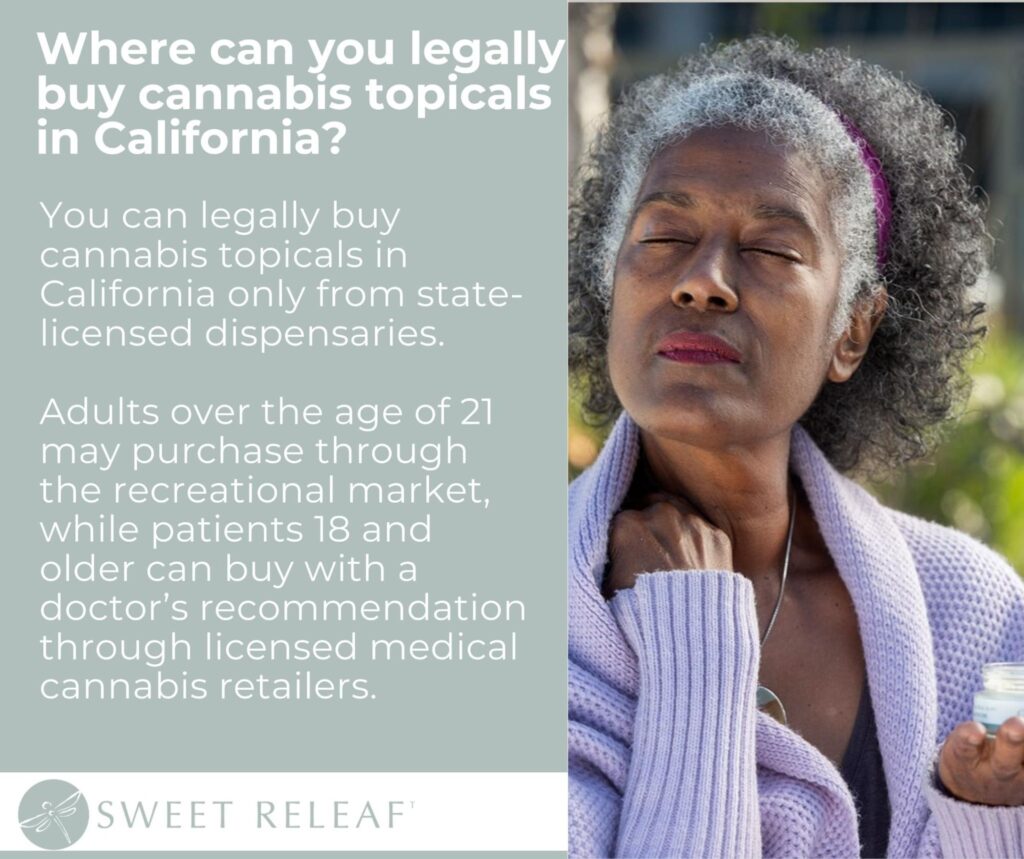
Age requirements for THC topicals in California follow the same structure as other regulated cannabis products. For adult-use purchases, buyers must be twenty-one or older.
A valid, government-issued photo ID is required at the point of sale, and licensed dispensaries are obligated to verify age before completing any transaction.
Medical access follows a different threshold. Patients who are eighteen or older may purchase THC topicals with a physician’s recommendation. This pathway allows younger adults dealing with documented health conditions to obtain cannabis products within the state’s medical framework.
Regulation does not stop at the counter. California law also governs how cannabis products are presented to the public. Marketing and packaging cannot appeal to minors. Labels must meet strict design standards, and products cannot be branded in ways that resemble candy, toys, or youth-oriented goods.
How to Choose Your THC Topical
After someone has spent money on a cannabis cream that delivered very little, skepticism is rational. The topical category includes everything from lightly infused hemp balms to high-THC formulations built for targeted relief.
Selecting the right product requires looking beyond branding and focusing on how the cream is made, how it is regulated, and how it is formulated to perform.
What to Look For in a Legal Topical
A reliable THC topical should meet clear standards in both compliance and formulation.
- Manufactured by a licensed California cannabis producer operating within the state’s regulated system
- Clearly labeled THC content so potency is transparent
- Whole-plant extract rather than isolated distillate when full-spectrum support is desired
- Verified lab testing for potency and contaminants
- A professionally formulated base that absorbs efficiently and leaves no heavy residue
These elements separate a regulated therapeutic product from a loosely defined wellness balm.
The label alone does not reveal how a cream will behave once applied. Extraction method, cannabinoid concentration, and delivery system determine whether a topical simply moisturizes or provides meaningful localized support.
Why Sweet Releaf Products Stand Apart
Sweet Releaf built its reputation on high-THC, whole-plant topical formulations designed within California’s licensed cannabis framework. The formulations prioritize cannabinoid concentration while maintaining cosmetic quality.
Full-spectrum cannabis is used to preserve the broader profile of plant compounds. The emulsion-based body butter structure allows cannabinoids to absorb efficiently without leaving a greasy finish. No toxic preservatives are used, and production remains small-batch and family-owned.
Long-standing customer trust reflects consistent formulation and regulatory compliance.
Legal Sweet Releaf Products to Try
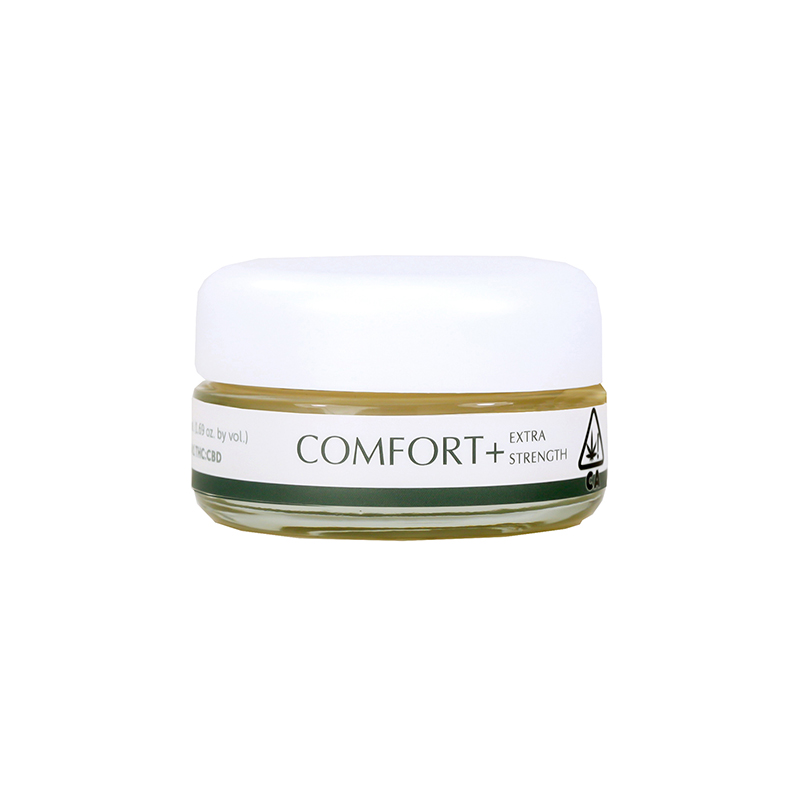
- Comfort+ Extra Strength Body Butter
Effective for chronic joint pain, arthritis-related stiffness, and post-surgical massage support, this high-THC emulsion delivers concentrated, localized relief.
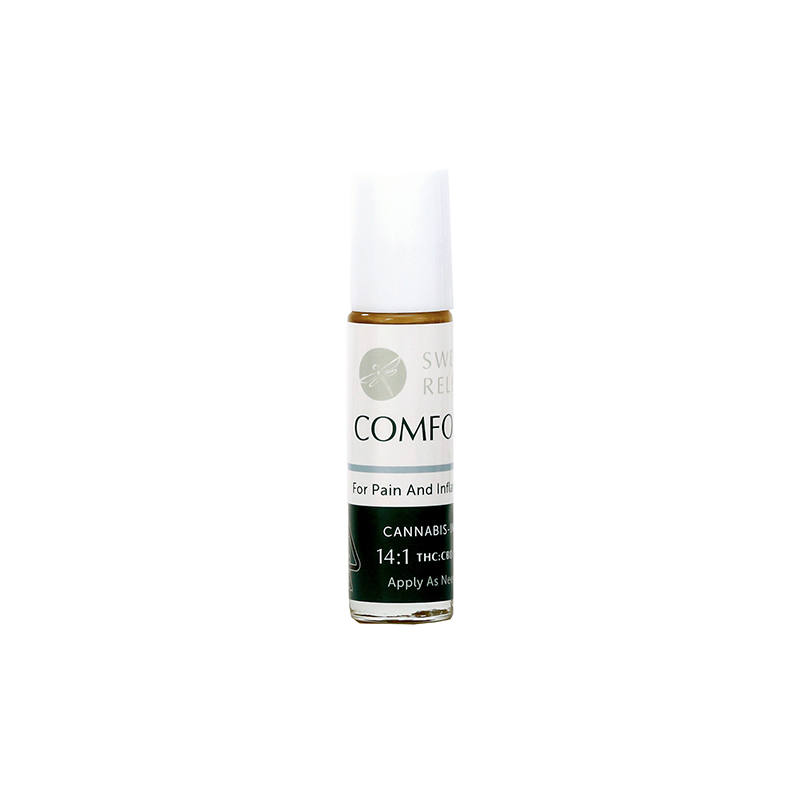
- Comfort Cools Dry Oil Roll On
Formulated for on-the-go application, this cooling topical supports neck tension, post-workout soreness, and targeted daily use without residue.
When You Understand the Law, the Decision Gets Easier
The legality of cannabis topicals becomes far less intimidating once you understand where federal law ends and state regulation begins. In California, properly licensed THC creams are legal, regulated, and non-psychoactive when used as intended.
So at least for those lucky enough to reside in the Golden State, choices are easy. You have access to premium plant medicine, including high-performing THC creams from Sweet Releaf which are within reach or medical as well as recreational users.
Look out for our logo in your local dispensary and if you don’t find it, tell them to order free samples directly from us.