Cannabis medicine is still being mapped, especially when it comes to topical applications for chronic inflammatory skin conditions like psoriasis. We have early clinical data, strong laboratory research, and mounting real-world experience.
Psoriasis pushes people to explore. Over time, many people start looking for something that works locally, directly in the skin, without adding systemic burden.
Topical cannabinoids are drawing attention for specific reasons. Research suggests they may:
- Reduce inflammatory signaling in overactive skin
- Calm persistent itching by interacting with local nerve pathways
- Ease tenderness and burning within thick plaques
- Help regulate rapid skin cell turnover
Sweet Releaf has focused on high-THC, full-spectrum topicals formulated to penetrate deeply while remaining non-psychoactive. This approach offers a lot of promise for people who failed to gain meaningful results with weaker creams.
In the sections ahead, we’ll examine why psoriasis is difficult to manage, how THC topicals interact with the skin’s own receptor system, and what current scientific research actually supports.
Psoriasis Facts to Keep In Mind
Psoriasis behaves like a skin condition. It feels like a skin condition. But biologically, it starts in the immune system and then recruits the skin as its stage.
When you keep that in mind, the rest begins to make sense.
How Psoriasis Affects the Patient
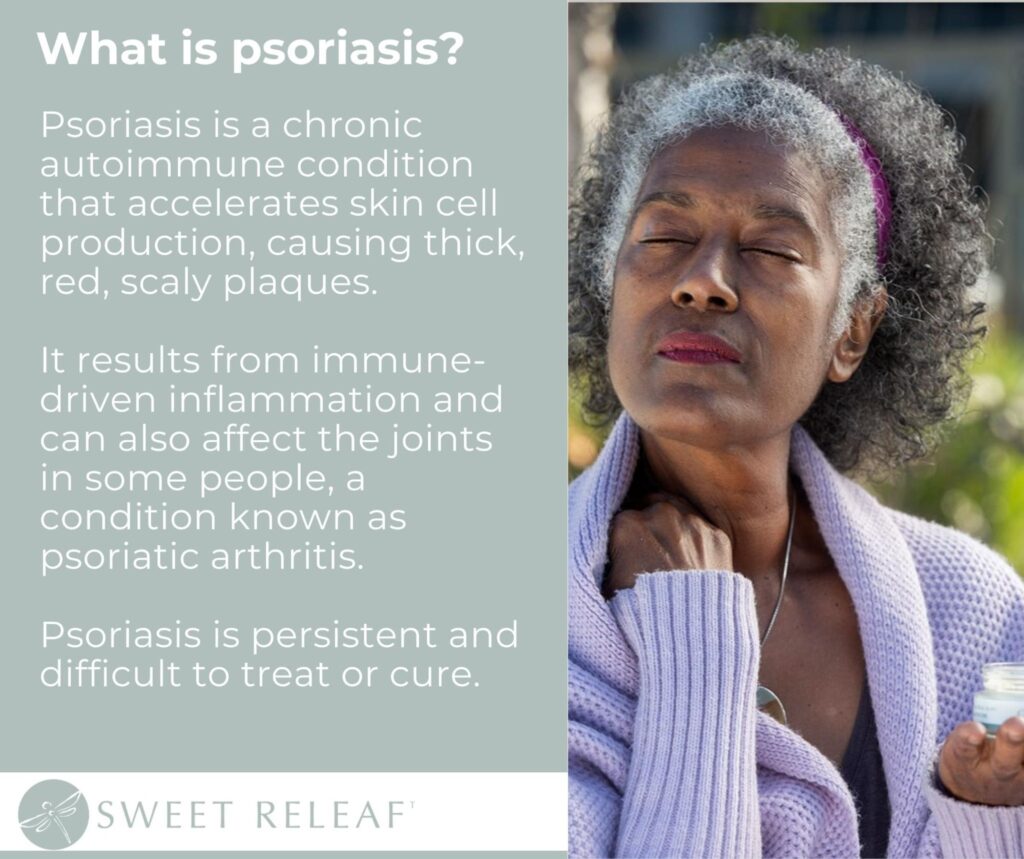
Psoriasis is driven by immune cells that signal the skin to grow faster than it should. In healthy skin, a cell takes about a month to mature and shed. In psoriasis, that timeline compresses to just a few days.
The result is buildup.
Skin cells accumulate faster than they can shed. They stack into plaques. Those plaques thicken, harden, and become inflamed.
What patients experience is not subtle:
- Raised red patches with silvery scale
- Skin that splits and bleeds when stretched
- Persistent itching that can feel electrical rather than superficial
- Burning or tenderness in areas of heavy plaque formation
For some people, the immune activity extends into the joints. Psoriatic arthritis brings stiffness, swelling, and joint degradation over time. The skin becomes the visible part of a deeper immune imbalance.
What Are the Biggest Psoriasis Triggers
Flares often follow patterns. The immune system responds to certain inputs with more aggression.
Common triggers include:
- Psychological stress, which elevates inflammatory cytokines
- Skin trauma, even minor friction or scratching, a reaction known as the Koebner phenomenon
- Cold, dry weather that compromises barrier function
- Bacterial or viral infections
- Genetic predisposition that alters immune signaling from birth
Many people notice improvement with moderate sun exposure because ultraviolet light can slow excessive skin cell proliferation.
That benefit comes with tradeoffs. UV radiation also accelerates skin aging and increases long-term cancer risk. Geography, skin tone, and medical history all influence whether sunlight is a viable strategy.
Why Psoriasis Is So Difficult to Treat
Psoriasis resists simple solutions because it operates on immune feedback loops.
Topical steroids suppress inflammation quickly. Over time, skin adapts. Stronger formulations are required. Thinning of the skin becomes a risk.
Systemic drugs reduce immune signaling more broadly. They can bring significant relief, yet they carry infection risk and require laboratory monitoring.
Light therapy can interrupt rapid cell growth. It demands consistency and access to clinical equipment.
Psoriasis persists because it is chronic, immune-driven, and responsive to both internal stress and external injury. Any meaningful approach has to account for that complexity.
How Cannabis Topicals Interact with Psoriatic Skin
Psoriasis is driven by immune overactivity and runaway skin cell production. Any topical that claims to help has to influence one of those two processes. Cannabinoids are interesting because the skin already has receptor systems designed to respond to them.
The Endocannabinoid System in the Skin
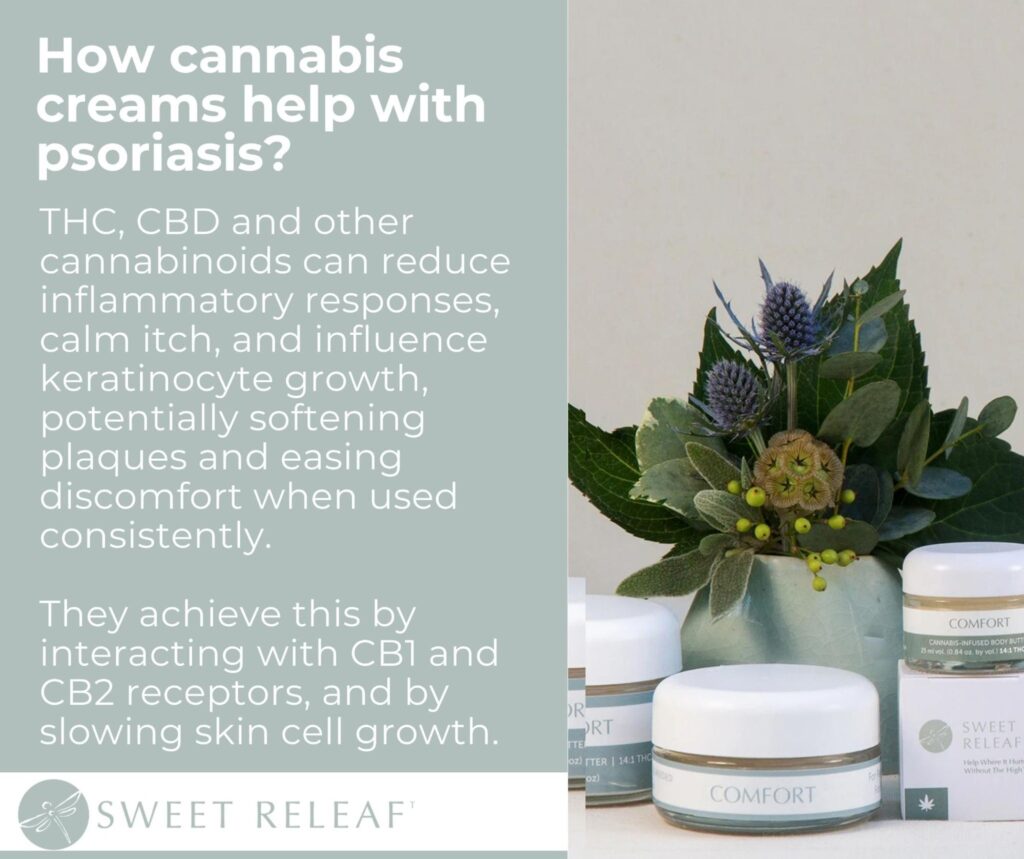
Human skin contains an active endocannabinoid system. CB1 and CB2 receptors are expressed in keratinocytes, immune cells, sebaceous glands, and sensory nerve endings. These receptors help regulate inflammatory signaling, immune response, barrier stability, and itch perception.
In psoriasis, inflammatory cytokines such as TNF-α and interleukins drive persistent immune activation. That immune signaling accelerates keratinocyte growth and sustains redness and swelling. When cannabinoids bind to CB1 and CB2 receptors in the skin, they can influence how those inflammatory signals are released and amplified.
Topical application keeps this interaction local. The cannabinoids engage receptors in the skin tissue itself rather than circulating widely through the bloodstream.
For an inflammatory condition concentrated in visible plaques, that localized receptor engagement is clinically relevant.
Slowing Rapid Skin Cell Growth
A defining feature of psoriasis is accelerated keratinocyte proliferation. Instead of maturing over several weeks, skin cells rise and accumulate within days. The surface thickens because shedding cannot keep pace with production.
Laboratory studies have shown that certain cannabinoids can inhibit excessive keratinocyte proliferation in vitro. When cell growth slows toward a more regulated pace, scaling may gradually reduce and plaque thickness can soften.
While laboratory models do not guarantee the same degree of change in living patients, they confirm that cannabinoids act directly on the very cells that misfire in psoriasis.
Itch and Pain Relief, Often the First Noticeable Shift
Many individuals report that itching decreases before plaques visibly change. That pattern reflects how cannabinoids interact with sensory nerve fibers in the skin.
Cannabinoids modulate peripheral nerve signaling and can reduce the intensity of itch transmission. THC binds strongly to CB1 receptors, which are involved in neural signaling. CBD interacts more indirectly with the same system.
That difference in receptor affinity may explain why THC-forward formulations are often described as more immediately soothing in inflammatory skin conditions.
Emerging Evidence About Topical THC for Psoriasis
Interest in topical THC for psoriasis is no longer limited to theory. A small but growing body of clinical and observational data has begun to explore whether cannabinoids can influence measurable disease severity.
Early Clinical Signals
A 2024 randomized, single-blind crossover study evaluated a topical cream containing THC and CBD in patients with psoriasis. The trial included 20 participants and measured outcomes using the Psoriasis Area and Severity Index.
The THC:CBD formulation was associated with statistically significant PASI improvement over the treatment period, and a combination formula that included additional botanical ingredients demonstrated even greater improvement. No significant adverse events or meaningful laboratory abnormalities were reported in this small cohort.
While this trial was limited in size, it provides reasons for optimism.
CBD-focused research has also explored topical application in inflammatory skin disease. A clinical study examining a CBD ointment in inflammatory skin conditions, including psoriasis, reported improvements in skin hydration and PASI scores without reported irritant reactions.
These findings suggest that potency may influence response, particularly in thick plaque presentations.
What Science Hasn’t Proven Yet
Large-scale, multi-center, placebo-controlled dermatology trials evaluating high-THC topical formulations for psoriasis have not yet been completed. Long-term safety data specific to daily use on inflamed plaques remain limited.
That’s why it’s crucial to be aware that cannabis topicals have not been established as curative therapies, and their role may only be supportive.
Current evidence suggests potential symptom modulation. It does not replace systemic care for moderate to severe disease. For many individuals, topical cannabinoids may function as part of a broader management strategy rather than a standalone intervention.
Why High-THC Creams Are the Only Match for Psoriasis
If you are specifically evaluating cannabis topicals for psoriasis, the real question is this: does potency matter? For inflamed, thickened plaques driven by immune overactivity, concentration determines whether cannabinoids meaningfully engage receptors in the skin.
Potency and Penetration
Psoriatic plaques are structurally thick. Accelerated keratinocyte turnover creates compacted layers that slow passive absorption. A low-percentage cannabinoid cream may hydrate the surface while delivering minimal active compound into deeper epidermal layers where CB1 and CB2 receptors are expressed.
Higher THC concentration increases the likelihood that enough active compound reaches those receptors to influence inflammatory signaling and nerve activity. This is particularly relevant for stubborn plaques that have persisted through multiple treatment cycles.
Formulation determines whether that potency is usable. Wax-heavy salves create occlusion, which can soften plaques but may limit dispersion of active cannabinoids. Straight oils spread quickly but can migrate before sustained absorption occurs.
An emulsified body butter distributes cannabinoids in a stabilized mixture of water and lipids. That structure supports even coverage and improves epidermal absorption compared to dense wax-based balms. For thick inflammatory lesions, delivery mechanics directly affect outcome.
Whole-Plant vs Distillate
Full-spectrum extracts contain THC alongside minor cannabinoids and terpenes. These compounds interact with the endocannabinoid system in overlapping ways that influence immune modulation and inflammatory signaling.
Distillates and isolates narrow that interaction to a single dominant molecule. In a condition involving multiple immune mediators, a broader cannabinoid profile aligns more closely with the biological complexity of psoriasis.
What Makes Sweet Releaf Different
Sweet Releaf formulates high-THC, full-spectrum topicals designed for localized application without psychoactive effect. The emphasis is on receptor interaction within the skin rather than systemic exposure.
The emulsion body butter base supports absorption through thickened tissue. Formulas avoid unnecessary preservatives and rely on whole-plant extracts. The company began as a small family operation focused on performance, and that standard remains central to product development.
Best Sweet Releaf Product for Psoriasis Support
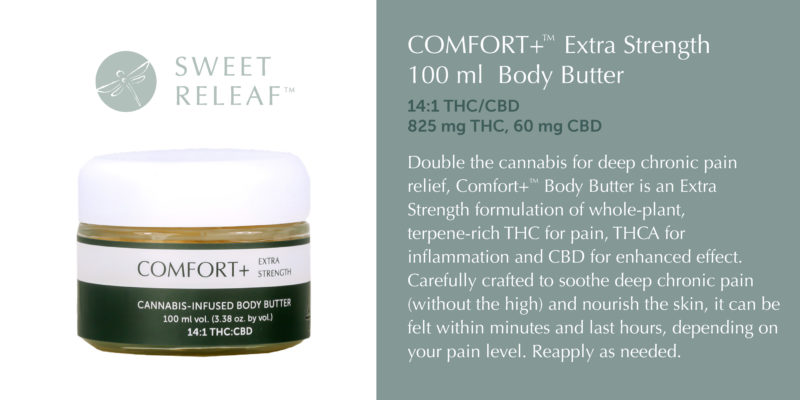
For those seeking a high-potency option formulated for deeper skin absorption, Comfort+ Extra Strength Body Butter delivers a concentrated, full-spectrum THC profile in an emulsified base.
A Practical Game Plan for Controlling Psoriasis with Topicals
Topical treatment for psoriasis tends to fail for one simple reason: inconsistency. People apply heavily for a few days during a flare, stop once the skin calms slightly, then restart when plaques thicken again.
Psoriasis does not respond well to that pattern. It behaves more predictably when the approach is steady and deliberate.
During a Flare
When plaques are active, preparation affects outcome. Gently cleansing the area removes surface scale and allows better contact between the topical and inflamed tissue. Applying to slightly damp skin can soften the outer layer just enough to improve absorption without trapping excess moisture.
Frequency matters. A moderate amount applied two or three times daily usually produces more stable results than a single heavy application. The goal is ongoing receptor engagement in the skin rather than sporadic saturation.
If prescription topicals are part of your regimen, timing becomes important. Many dermatologists advise allowing medicated creams to absorb fully before layering additional products. Cannabinoid topicals can function alongside conventional treatments, provided they are applied thoughtfully rather than haphazardly.
Scalp plaques require direct access to the skin. Parting the hair and working the product into affected areas improves contact. Addressing itch early reduces scratching, which can trigger additional lesions through mechanical irritation.
Long-Term Maintenance
As plaques thin, routine becomes the stabilizing factor. Continued application during calmer periods may help maintain a lower inflammatory baseline. Abruptly stopping and restarting often leads to fluctuation.
Keeping notes can clarify patterns. Changes in weather, stress levels, sleep quality, and diet frequently correlate with skin shifts. Adjusting one variable at a time makes it easier to see what influences improvement.
Stress reduction plays a measurable role. Psychological stress increases inflammatory signaling, which can amplify flares. Skin management and nervous system regulation are closely linked.
When to Talk to Your Doctor
Extensive plaque coverage, joint stiffness, rapidly spreading lesions, or worsening inflammation warrant medical evaluation.
Individuals using systemic immunosuppressants should coordinate any adjunct topical strategy with their physician. If irritation increases or symptoms escalate rather than stabilize, professional guidance becomes necessary.
Topicals work best when they are part of a steady, informed plan rather than a reaction to the latest flare.
Where Cannabis Topicals Fit in Psoriasis Care
Living with psoriasis means negotiating with your immune system on a daily basis. Some days it cooperates. Some days it does not. Inflammation becomes a fact of life, and the only question is how directly you can influence it at the level of the skin.
Topical THC offers a localized way to engage immune signaling and excessive cell turnover without adding systemic burden. That makes it a reasonable consideration for people who want more control over persistent plaques while remaining anchored in medical care.
If you decide to test that approach, use a cream built for inflamed tissue rather than cosmetic hydration. Sweet Releaf’s high-THC, full-spectrum body butters were developed for conditions where mild formulas fail. Look for them in dispensaries or contact us for more info.