For many people, drug testing is a fact of life, whether you’re in healthcare, construction, athletics, public safety, or starting a new job. A screening can determine employment, licensing, insurance eligibility, or professional standing.
Now consider this situation: you are managing joint pain, nerve irritation, or post-surgical inflammation with a cannabis product that does not make you feel high, and your test still comes back positive.
Cannabis exists in many forms, and labeling has created confusion. Terms like “full-spectrum,” “non-psychoactive,” and “CBD-only” sound reassuring, yet they do not always explain how a product behaves in the body or how it appears in a lab report.
Before we move into the physiology and the testing science, here are the main things to know about THC topicals and drug tests:
- Most topicals stay in the skin and do not enter the bloodstream, which means they usually will not trigger a positive result.
- Transdermal products are designed to move cannabinoids through the skin and into circulation, and those can show up on a test.
- CBD creams labeled hemp-derived may still contain trace THC that can be detected under certain conditions.
- Drug tests do not measure how cannabis was used; they detect THC metabolites in the body regardless of delivery method.
- Laboratory errors and mislabeled products can create unexpected positive results with serious professional consequences.
- Safe use depends on reading labels carefully and choosing formulations that are designed to remain localized.
That is where Sweet Releaf comes in. We formulate high-THC, non-psychoactive topicals that deliver deep relief while remaining localized in the skin. Our products have an impact, but they won’t put the consumer at risk of failing a drug test.

In this guide, I will walk you through how these products work, how drug tests actually function, and how to choose relief that supports your body without putting your livelihood at risk.
A Few Words about Cannabis Topicals
When I formulate a topical, I am thinking about the skin first. The skin is a living organ with its own signaling system, including cannabinoid receptors that respond to compounds like THC and CBD. A cream or body butter is designed to work with those receptors locally.
That design choice is what separates a true topical from other forms of cannabis and what determines whether a drug test becomes part of the conversation.
Local Relief, No High
Cannabis topicals are lotions, creams, balms, and oils applied directly to the skin for targeted relief. They interact with the endocannabinoid system in the epidermis and dermis rather than entering systemic circulation.
The outermost layer of skin, the stratum corneum, acts as a selective barrier. In properly formulated products, cannabinoids bind to local receptors involved in inflammation, nerve signaling, and muscle tension without crossing into the bloodstream.
Because they remain localized, standard THC topicals do not cross the blood brain barrier. That is why a well-made topical does not alter mood, perception, or cognition.
Seniors managing arthritis, athletes working through repetitive strain, and patients recovering from surgery often choose this route because they want relief that allows them to stay clear and functional throughout the day.
Different Than Smoked or Ingested Cannabis
When cannabis is inhaled or eaten, THC enters the bloodstream and travels to the liver, where it is metabolized into compounds such as THC COOH. Those metabolites are what urine tests are designed to detect.
That pathway simply does not apply to a properly formulated topical. Topicals bypass first pass liver metabolism because they are not intended to reach systemic circulation. Bioavailability through the skin remains an active area of research, and some manufacturers experiment with technologies that increase penetration.
Still, basic difference is clear. Smoking and edibles produce whole body effects. A topical should stay where you apply it and act there.
THC vs. CBD Topicals: What’s the Difference?
CBD and THC topicals may sit next to each other on a dispensary shelf, yet they begin with different plant sources and different formulation goals.
CBD dominant creams are typically derived from hemp, which by legal definition contains very low levels of THC. The extract may be processed into full-spectrum oil, broad-spectrum oil with most THC removed, or pure CBD isolate. Each of those extracts is then blended into a carrier base such as shea butter, coconut oil, or an emulsion cream designed for skin absorption.
THC dominant topicals are usually made from cannabis flower or whole-plant material with higher concentrations of delta-9 THC. In a well-crafted formula, the resin-rich parts of the plant are infused into fats or emulsified into creams so the cannabinoids can interact with receptors in the skin.
Some manufacturers rely on distillate, which isolates THC into a single compound. Others use whole-plant infusions that retain minor cannabinoids and aromatic compounds that influence how the product feels and performs on the body.
In terms of user impact, CBD creams are often chosen for mild to moderate inflammation, surface irritation, or general muscle fatigue. Many people describe them as soothing and steady. THC dominant topicals tend to produce a deeper, more noticeable easing of nerve sensitivity and stubborn joint pain.

Drug Testing at a Glance
Before we go any further, it helps to look at drug testing for what it is.
These tests are biochemical screens designed to detect specific metabolites. They are not moral judgments, and they are not designed to interpret intent. They simply measure what is present in the body at the time of testing.
Why You’re Tested in the First Place
Drug screening shows up in many areas of modern life. It is often required for:
- Employment, especially in safety-sensitive fields
- Athletic programs and competitive sports
- Healthcare licensing and credentialing
- Probation or court supervision
- Insurance underwriting or workplace compliance
Most tests are built to detect THC metabolites, particularly THC-COOH in urine. They do not distinguish between THC from smoking, ingesting, or another route of exposure.
The lab is not evaluating whether someone felt high. It is measuring whether metabolites formed after THC entered systemic circulation. That distinction explains why legality and intoxication level are separate from what appears on a report.
What Happens If You Fail
A positive result can carry consequences that extend far beyond a single conversation with an employer. People have lost jobs, had contracts revoked, or faced professional review from licensing boards after a positive THC screen. In regulated professions such as nursing or commercial driving, the outcome can involve formal reporting requirements.
The emotional impact can be heavy. Many individuals believe that using a legal hemp product or a non-intoxicating cannabis cream places them outside the scope of risk.
When a test says otherwise, the experience often brings confusion and a sense of being misled by labeling or marketing language. That reaction is understandable, especially when the product never altered mood or function.
Comparison Table: Drug Testing Methods
Different tests measure different things and operate on different timelines. Here is a practical overview:

The key pattern is this: detection depends on systemic exposure. When cannabinoids remain localized in the skin, metabolites that tests are designed to measure do not form in measurable amounts.
You Can Fail a Drug Test from a Topical, But Only In These Situations
Up to this point, we have been talking about properly formulated, localized topicals. Those products are designed to stay in the skin. There are, however, specific situations where the line between topical and systemic use becomes blurred. That is where risk enters the picture.
The Transdermal Trap
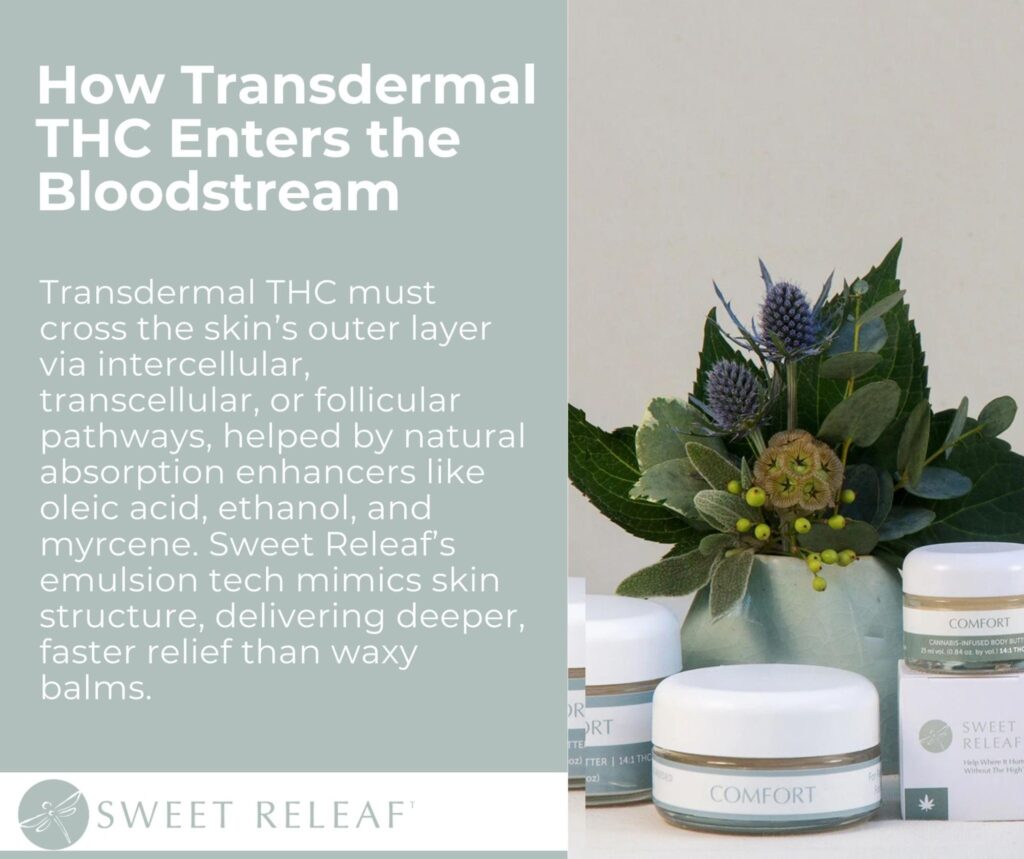
Some products marketed alongside creams and balms are not truly topical in the localized sense. Transdermal patches are engineered with a different goal. Their purpose is to move cannabinoids across the skin barrier and into the bloodstream over time.
Once cannabinoids enter circulation, the liver metabolizes THC into compounds that standard drug tests are built to detect.
To accomplish that systemic impact, transdermal products often rely on permeation enhancers. These are chemical or solvent-based agents designed to loosen the tightly packed structure of the outer skin layer so larger molecules can pass through.
From a medical delivery standpoint, that technology makes sense.
From a drug testing standpoint, it changes the equation entirely. A patch designed for steady release into circulation should be viewed as a systemic product, not a localized cream.
Red Flags to Watch For
The language on the label usually tells the story. Words such as transdermal, extended relief, systemic effect, or slow release signal that the product is intended to move beyond the surface of the skin.
Those terms are not marketing decoration. They describe the delivery mechanism.
Ingredient lists can offer additional clues. Compounds such as ethanol, DMSO, and other chemical penetration enhancers are often included specifically to increase absorption into deeper tissues and potentially into circulation.
A product built for localized action typically relies on plant-based fats and emulsion systems rather than aggressive penetration chemistry.
False Positives: When the Test Itself Gets It Wrong
While formulation is the primary factor, laboratory error remains a separate issue. Initial urine screens often rely on immunoassay methods that are designed for speed and cost efficiency. These tests can occasionally cross-react with unrelated compounds, including certain anti-inflammatory medications or other prescriptions, producing a preliminary positive result.
When that happens, confirmatory testing using gas chromatography–mass spectrometry provides a far more precise analysis. GC-MS separates and identifies specific molecules, greatly reducing the chance of a false flag.
In professions that use rapid screening as a first step, it is wise to know the retesting procedures and the right to request confirmatory analysis. A single preliminary result does not always tell the whole story.
How to Choose a Test-Proof THC Topical
When drug testing is part of your professional life, choosing a topical becomes a matter of formulation transparency. That means paying attention to how a product is built, what type of extract it uses, and whether the delivery system is designed to stay within the skin.
A trustworthy topical should clearly state that it is non-transdermal, avoid penetration enhancers, and rely on a base that supports tissue absorption without pushing cannabinoids into circulation.
Sweet Releaf Is a Topical Maker You Can Trust
Sweet Releaf formulas are non-transdermal and non-psychoactive by design. They are optimized for deep, localized action without entering the bloodstream.
The products use whole-plant cannabis rather than isolated distillate, allowing the natural cannabinoid profile to interact with receptors in the skin and underlying tissue. The base materials are plant butters and oils structured to support absorption into muscle and connective tissue without chemical enhancers such as DMSO or aggressive solvents.
The result is targeted relief with a delivery method that aligns with drug-testing safety.
Our Best Products for Potent but Safe Relief
- Comfort Body Butter
An emulsion-based formula that allows cannabinoids to absorb deeply into joints and muscles while remaining localized in the skin. High THC content supports meaningful pain relief.

2. Comfort Cools Dry Oil
A fast-absorbing cooling oil inspired by Ayurvedic principles. High-potency cannabis is paired with botanicals that calm heat and inflammation. The dry texture makes it practical for use before work, after physical activity, or during flare-ups.

Seeking Clarity in a World of Cannabis Confusion
For people who rely on pain relief but live with the looming reality of drug testing, the landscape can feel like a minefield. One wrong label, one misleading product, and your livelihood could be at risk.
But here’s the truth: there are certain cannabis products that won’t get you in trouble. The whole trick is knowing where to find them, and Sweet Releaf can help you with that.
We make our topicals for people who want to move freely in their bodies without compromising their jobs or their standing in the community. They deliver clear benefits, but never leave behind residue that could trigger a positive test.
If that’s something you might be interested in, just find your nearest Sweet Releaf retailer and ask about our products.