Cannabis topicals are widely considered very safe and well tolerated. For most people, there are no meaningful side effects to worry about when using a properly formulated product as directed. They are designed for localized use and do not create systemic concerns.
No “Weed Effects” from a Knee Cream
When people hear the word cannabis, they often associate it with the trademark elements of a recreational experience. That mental association is powerful, which is why the question about side effects feels urgent when the product in question is a cream for sore joints or tight muscles.
The expectation does not match the reality.
Cannabis balms and creams are designed for localized use. They are applied to the body, not consumed for a mental effect. A properly formulated topical works in the tissue where it is placed and does not create whole-body changes.
Here is what cannabis topicals typically DO NOT cause:
- Feeling high or intoxicated
- Brain fog or impaired thinking
- Paranoia or anxiety spikes
- Increased heart rate
- Dry mouth or dry eyes
- Impaired driving or unsafe work performance
This distinction is central to how these products function. Sweet Releaf is a family-owned brand that focuses specifically on high-THC topicals formulated for physical relief while keeping the mind clear. Our creams are made with whole-plant cannabis and skin-friendly ingredients chosen for absorption and consistency.
In the sections ahead, we will examine why topicals bypass the classic cannabis side effects, whether tolerance or dependency should be a concern, and the rare issues that can arise when a product is poorly formulated or applied incorrectly.
Why Topicals Don’t Have the Classic Side Effects of Weed
The confusion around cannabis topicals usually starts with a category error. People hear “THC” and assume every product containing it behaves the same way. In reality, the delivery method largely determines the outcome. A compound applied to the skin does not travel the same biological path as one inhaled into the lungs or digested through the gut. That distinction changes everything.
The Local Mechanism of Action
The skin is not a passive barrier. It is biologically active tissue with its own network of cannabinoid receptors, especially CB2 receptors embedded in skin cells, immune cells, and peripheral nerve endings.
When a topical is massaged into sore tissue, the cannabinoids interact primarily within this local receptor environment.
A properly formulated cream is engineered to work within those upper tissue layers. It penetrates enough to reach muscles and connective tissue beneath the skin, yet it is not designed to flood systemic circulation.
The activity remains focused on the area of application. That is why a cream applied to a shoulder behaves like a targeted tool rather than a full-body experience. The biological pathway simply does not route it toward the brain in meaningful amounts.
Most THC Side Effects Come From Intoxication
The effects people associate with THC arise when the compound enters the bloodstream, reaches the central nervous system, and activates receptors in the brain.
That interaction can alter perception, reaction time, mood, and cognition. Those changes define the experience many people either seek or avoid.
Topicals do not follow that route. Without significant systemic distribution, there is no substantial engagement with brain receptors. The feared mental effects are tied to intoxication, and intoxication requires circulation. A localized cream does not create that condition.
True Topicals Bypass Intoxication Entirely
There is a practical distinction worth noting. Transdermal systems are engineered to push cannabinoids across the skin barrier and into the bloodstream over time. That design can produce systemic exposure.
Traditional creams and body butters are built differently. Their goal is localized relief, not delivery to the brain. That is why people can apply a well-formulated topical before heading to work, driving across town, or spending the afternoon in the garden. The relief is physical and focused, and mental clarity remains intact.
Tolerance & Addiction: Should You Worry?
This is where people get quiet.
They might feel fine about using a cream on their knee, but somewhere in the back of their mind is the question: “Wait… isn’t THC addictive?” And right behind that comes another one: “Am I going to need more and more of this over time?”
Those concerns are shaped by experiences with smoking, edibles, and opioids. Topicals follow a very different pattern in real life.
What Observational Use Suggests in Real Life
Look at how people use a topical. They rub it into a sore wrist before work. They apply it to arthritic fingers in the morning. They reach for it after a long hike when their hips are barking.
Regular users tend to settle into a potency that works and stay with it. Many use the same formula for years because it delivers steady, predictable relief.
The tolerance building properties of marijuana and other drugs are simply absent from this approach. When the cream is used for a specific purpose, it tends to retain its effectiveness even during long-term use without the need for constant dose increases.
Why Topicals Don’t Reinforce Addictive Patterns
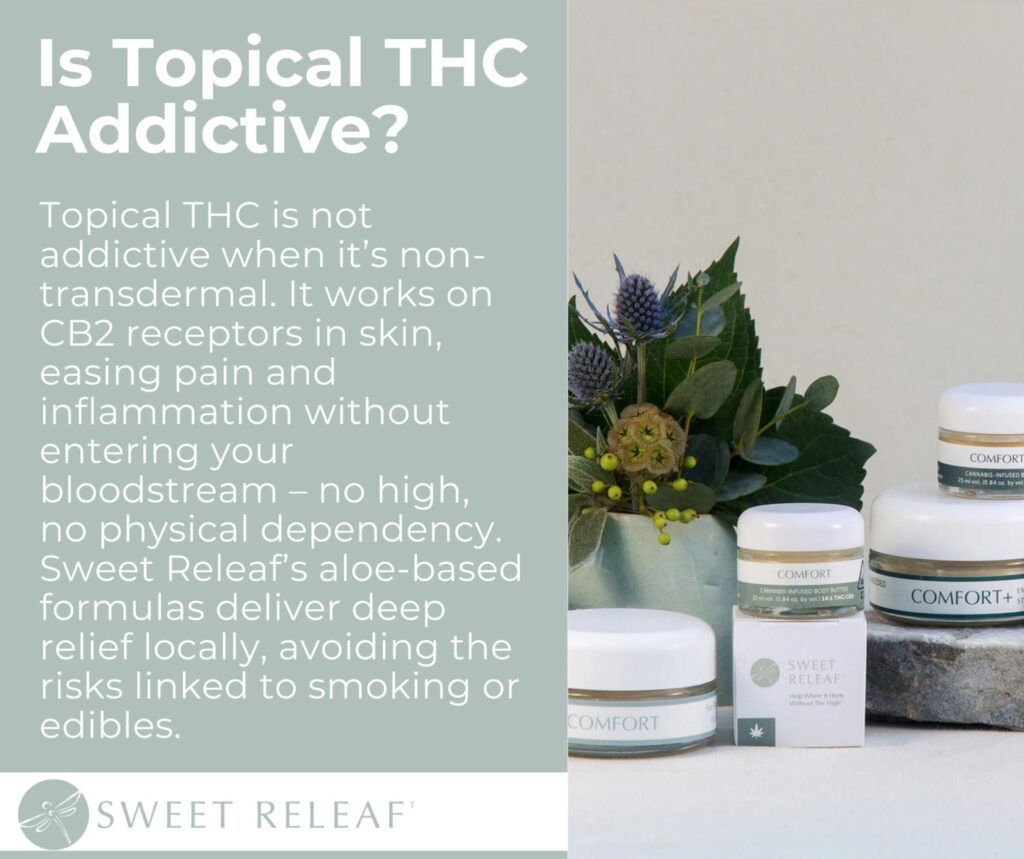
Addictive dynamics depend on reward circuitry. A substance alters mood or perception, the brain registers that shift as desirable, and repetition strengthens the pattern.
A true topical does not meaningfully engage that system. Its impact is peripheral and tissue-based. When someone stops using it, what returns is the original physical discomfort. There is no secondary layer of chemical rebound tied to mood or cognition.
That difference shapes the risk profile. Without a psychological reward tied to the next dose, the vicious circle of addiction never even starts.
Rare Side Effects of Cannabis Topicals
Cannabis topicals have a strong safety profile, especially when compared to systemic pain treatments. That said, any product applied to the skin can produce a reaction under the right conditions. When issues arise, they tend to be mild, localized, and tied to formulation rather than the cannabinoid itself.
Skin Irritation and Dryness
The most typical reactions are skin-level responses. Some people experience redness, mild itching, a temporary rash, dryness, or a warming sensation that feels more intense than expected. These effects usually stay confined to the area of application.
Individuals with sensitive or reactive skin notice changes more quickly because their barrier function is already more responsive to new ingredients. Someone prone to eczema, rosacea, or fragrance sensitivity may react to a product that others tolerate easily.
In many cases, the cannabinoid is not the source of irritation. THC and other plant compounds tend to be well tolerated when properly extracted and formulated. Reactions more often trace back to the surrounding ingredients or to applying a product on already compromised skin.
Risk of a Failed Drug Test
Drug testing anxiety shows up frequently in conversations about THC topicals. Standard creams and body butters are designed for localized interaction with skin and underlying tissue. They are not built to deliver cannabinoids into systemic circulation in meaningful amounts, which makes a positive result unlikely under normal use.
Risk can increase when a product is engineered for transdermal delivery, when labeling is inaccurate, or when manufacturing controls are loose. Contamination and potency misreporting introduce variables that are difficult to predict.
Practical reassurance comes down to product choice. A properly formulated topical from a tested, transparent manufacturer presents a very different risk profile than a mystery jar with unclear sourcing.
What Causes These Issues (Hint: Not THC)
When reactions occur, the underlying triggers are usually found in the formula or the way the product is used. Common contributors include:
- Added ingredients such as menthol, heavy fragrances, certain essential oils, or aggressive preservatives
- Low-quality carrier oils that sit on the surface, clog pores, or disrupt the skin barrier
- Contaminants including pesticides, heavy metals, or residual solvents in poorly tested cannabis
- Labeling inconsistencies that create uncertainty around actual potency and ingredient load
- Application to broken, freshly treated, or post-procedure skin where irritation risk is already elevated
How to Find a Safe Topical Cream
By this point, the real question shifts from “Are there side effects?” to “How do I choose a product that minimizes risk in the first place?”
Safety in cannabis topicals is less about the presence of THC and more about how the product is formulated, manufactured, and tested. A clean, well-built cream behaves very differently from a rushed, under-regulated one.
What “Safe” Really Means in Cannabis Topicals
A safe topical starts with clarity. Labels should state potency clearly and consistently, so you know exactly how much active cannabinoid is in the jar.
Reliable brands test for potency and contaminants through third-party labs, confirming that what is printed on the label matches what is inside.
Safety also depends on ingredient selection. Many irritation issues stem from aggressive additives, heavy fragrances, or unstable preservatives rather than from cannabis itself. A thoughtfully designed formula avoids those triggers and focuses on skin compatibility.
Finally, a safe topical is engineered for localized relief. It is built to work in the tissue where it is applied, rather than designed to push cannabinoids into systemic circulation. That distinction protects mental clarity and keeps the experience grounded in physical comfort.
How Sweet Releaf Makes Its Creams
Sweet Releaf operates as a family-owned, small-batch manufacturer, which allows close control over sourcing and production. The formulations rely on whole-plant, full-spectrum cannabis rather than isolated distillates, preserving a broader range of plant compounds within a controlled potency range.
The body butters are made as emulsions, blending oil and water phases to create a texture that absorbs efficiently instead of sitting heavily on the skin. This approach improves penetration into underlying tissue while maintaining a cosmetic finish that feels clean and smooth.
Ingredient selection prioritizes skin performance alongside pain support. The result is a cream that feels good to apply and behaves consistently from jar to jar.
Best Sweet Releaf Creams to Try with Zero Side Effects
- Comfort Body Butter for daily aches, muscle soreness, and general pain support.
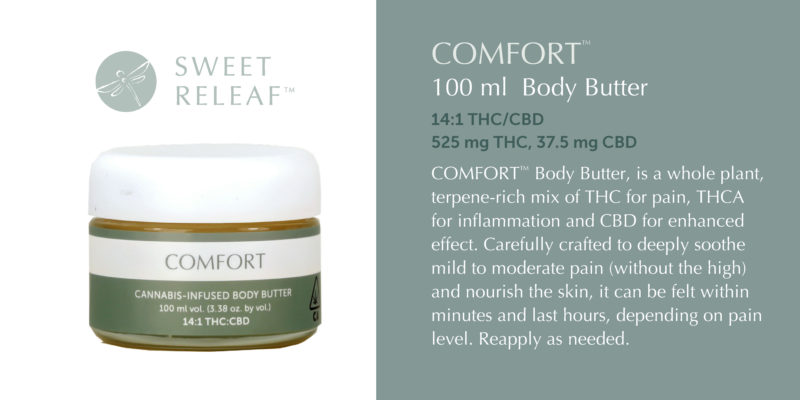
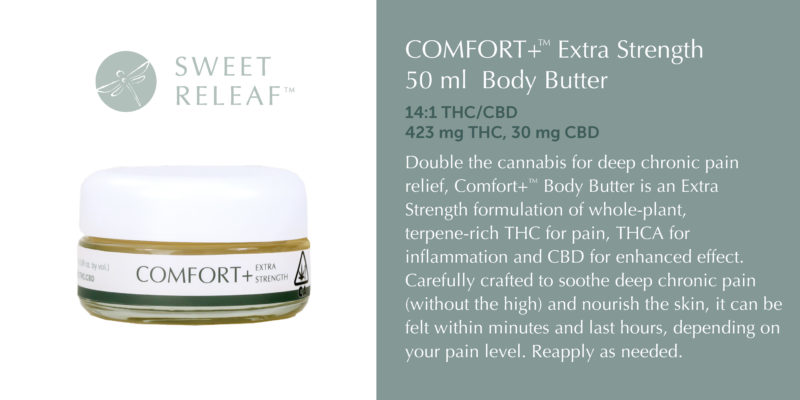
- Comfort+ Extra Strength Body Butter for chronic pain, stubbornly inflammed joints, and deeper discomfort.
The “Side Effect” Most People Don’t Expect
The side effects most people worry about never shows up.
The one that does is much more dangerous.
It’s buying a thin, underpowered cream with fancy packaging and barely any active cannabinoids, trying it once, and deciding cannabis topicals are overhyped.
That moment closes a door. It keeps people stuck cycling through pills, tolerating stiffness, scaling back movement, adjusting life around discomfort.
Worst of all, this scenario is very easy to avoid. All you need to do is get your cream from a company like Sweet Releaf that knows their cannabis.
Our products are available all over California. Walk into your local dispensary and ask about Sweet Releaf today!