Medical experts and U.S. agencies advise avoiding THC in any form during pregnancy, including creams and lotions, due to unknown fetal effects.
While most topicals stay local, risks, product mislabeling, and legal consequences make caution the safest choice.
Even if a cannabis cream never reaches your bloodstream, medical guidance from the FDA, CDC, and ACOG is clear: there’s simply not enough evidence to guarantee safety for your baby.
This is especially important to know if you’ve been using topicals for chronic pain or joint relief without thinking twice about pregnancy-specific risks.
Here’s how considerations may differ depending on your needs:
- Chronic pain relief – The temptation to continue is real, but medical input is key to weighing risk versus benefit.
- Muscle or joint aches – Safer, non-cannabis topicals can be equally effective for many people.
- Back pain or sciatica – Heat/cold therapy and pregnancy-safe massage may help without systemic exposure.
- Arthritis or old injuries – Some non-THC topicals may provide localized relief worth exploring.
- Migraine management – Discuss with your provider whether CBD isolate or non-cannabinoid topicals are viable.
In the sections ahead, we’ll walk through exactly what happens when THC reaches the placenta, whether topical creams can cause that, how to understand product labels, and what safe pain relief options exist.
We’ll also clear up confusion about legal testing and reporting, because that’s a real worry for many expectant parents.
As the maker of Sweet Releaf, I’ve seen how our THC-forward topicals transform lives by relieving pain without a high.
But during pregnancy, caution takes precedence.
If you’re reading this to decide your next step, I’ll help you understand the science, the risks, and the safest ways to care for yourself, so you can make a decision you feel confident about.
Can You Use Topical THC While Pregnant? Quick Answer & Why It Matters
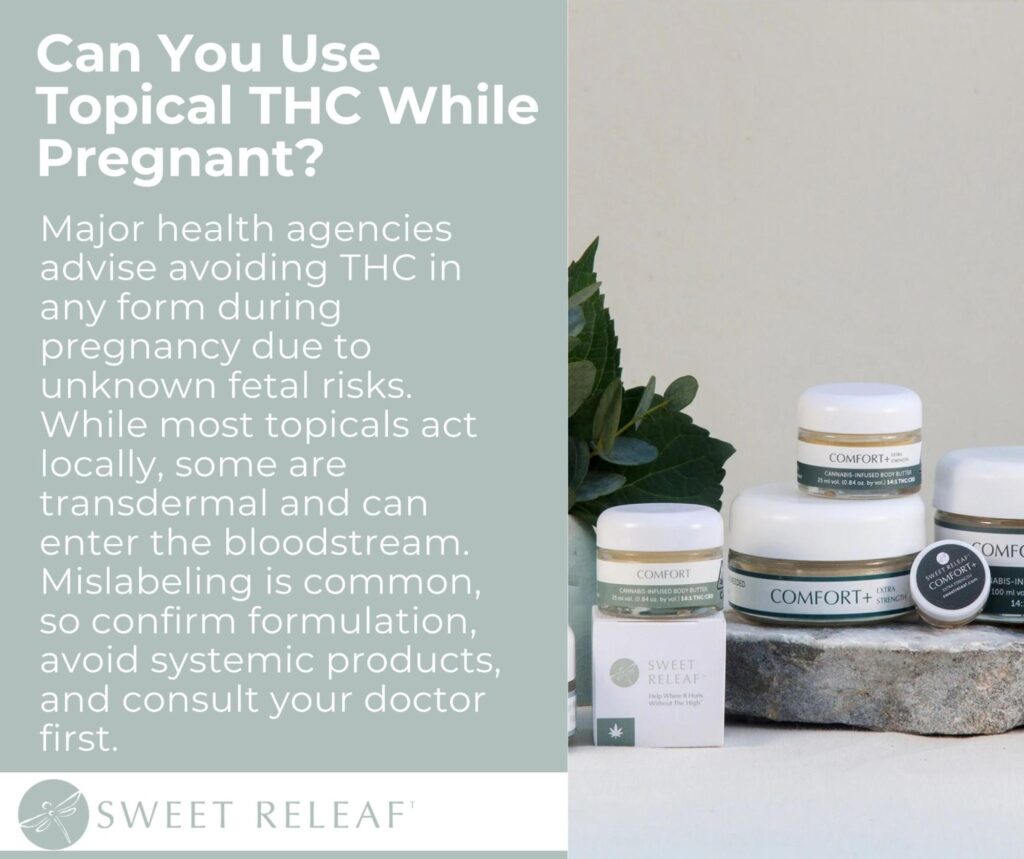
Major health authorities, including the FDA, CDC, and ACOG, advise against using THC in any form during pregnancy, whether inhaled, eaten, or applied to the skin.
This is because we don’t yet have enough data to rule out potential harm to the developing baby.
That said, not all products are created equal. Most topical cannabis creams are designed to work locally on muscles and joints without entering the bloodstream, meaning the risk of direct fetal exposure is lower.
But some “topicals” are actually transdermal products, patches, gels, or lotions formulated to penetrate the skin barrier and deliver cannabinoids into the bloodstream.
These can circulate throughout the body and potentially cross the placenta.
The problem is that product labeling is not always clear, and testing has shown that some THC-free creams actually contain THC.
Add in the possibility of legal consequences from drug testing during pregnancy, and you’ve got a mix of medical, safety, and legal factors that make caution the best path forward.
Here’s how the considerations can differ depending on your pain needs:
- Chronic pain relief – The urge to keep using a familiar product is understandable, but weigh the benefits against the unknown risks, ideally with guidance from your healthcare provider.
- Muscle or joint aches – Non-cannabis alternatives, such as menthol-based rubs, can be effective and remove THC exposure concerns.
- Back pain or sciatica – Targeted heat/cold therapy, prenatal massage, or physical therapy can be safer choices.
- Arthritis or old injuries – Some non-THC topicals may offer similar relief without cannabinoid exposure.
- Migraine management – Work with your provider to explore CBD isolate products or non-cannabinoid options that are considered safe in pregnancy.
What Medical Authorities Say
When it comes to pregnancy, the message from leading medical organizations is consistent: the safest choice is to avoid cannabis altogether, no matter the form.
The FDA and CDC both warn that THC and CBD can pose risks during pregnancy.
Research has linked prenatal cannabis exposure to low birth weight, premature delivery, and possible effects on brain development, including long-term changes in attention, memory, and behavior.
The CDC’s most recent update goes further, stating that cannabis “may be harmful no matter how you use it”, smoking, vaping, eating, or applying to the skin.
MotherToBaby, a trusted teratology information service, notes that studies on cannabis use in pregnancy show mixed results, with some suggesting an increased risk of birth defects, preterm birth, and stillbirth.
They emphasize that these studies often rely on self-reporting and may be confounded by other factors like tobacco use, making it difficult to measure a precise “safe” amount, if one exists at all.
OB/GYN reviews highlight an important distinction for those specifically asking about creams and lotions:
- Topical (local) products, like balms, salves, and emulsion-based body butters, are generally formulated to act on cannabinoid receptors in the skin and underlying tissues without entering the bloodstream.
- Transdermal products, such as medicated patches or certain gels, are specifically engineered to penetrate the skin barrier and deliver THC into circulation, making systemic exposure (and potential fetal exposure) far more likely.
The takeaway from these authorities is clear: until more conclusive evidence is available, any cannabis exposure in pregnancy should be approached with extreme caution, especially if there’s any chance the product delivers cannabinoids systemically.
How Topical THC Works
Understanding how THC behaves in different product types is key to making an informed choice.
Topical (non-transdermal) cannabis products, such as creams, salves, and body butters, are designed to work locally.
When applied to the skin, cannabinoids interact mainly with CB2 receptors in the skin, muscles, and peripheral nerves.
This can help reduce localized pain and inflammation without sending measurable THC into the bloodstream.
Because they’re not intended to penetrate deeply, these products generally do not cause psychoactive effects or systemic exposure.
Transdermal cannabis products, on the other hand, are built to cross the skin barrier and enter circulation.
Think patches, medicated gels, or specially formulated lotions with penetration enhancers.
These deliver a controlled dose of THC into the bloodstream over time, meaning the cannabinoids can circulate throughout the body, and potentially cross the placenta.
Why this matters in pregnancy:
Only products that enter the bloodstream can directly reach the fetus. While that makes non-transdermal topicals theoretically lower risk, mislabeling is a real concern.
Independent lab tests have found THC in products marketed as THC-free, and some creams labeled as “topical” are actually formulated for transdermal absorption.
Without clear labeling and third-party testing, it’s hard for consumers to know exactly what they’re using.
Helpful Resources => Does Topical THC Show on Drug Tests?
Real-World Confusion & Gaps in Guidance
Even with all the official recommendations, many pregnant people still struggle to get clear, consistent answers about topical THC use.
Lack of definitive safety data means there’s no yes-or-no from most providers when asked if local-only topicals are safe in pregnancy.
Some doctors will say “avoid all THC just to be sure,” while others will weigh potential benefits and risks on a case-by-case basis, leaving patients caught in the middle.
Labeling adds to the uncertainty. Independent lab testing has revealed that some “THC-free” CBD creams do, in fact, contain detectable THC.
Likewise, certain lotions marketed as “topical” are actually transdermal formulas intended for systemic delivery, which could increase fetal exposure risk.
Without third-party lab results, it’s almost impossible for a consumer to verify what’s inside.
Legal and policy differences create another layer of concern.
- Hospital drug testing protocols vary widely; some facilities routinely test mothers and newborns without explicit consent.
- Meconium testing can detect cannabis exposure going back four to five months, meaning even infrequent use earlier in pregnancy could appear on results.
- In some states, a positive result in the baby’s system automatically triggers a Child Protective Services (CPS) review, regardless of whether cannabis use was legal.
For expectant parents, these unknowns often make the risk feel bigger than the potential relief, especially when safer, pregnancy-approved alternatives are available.
What Happens When THC Reaches the Placenta
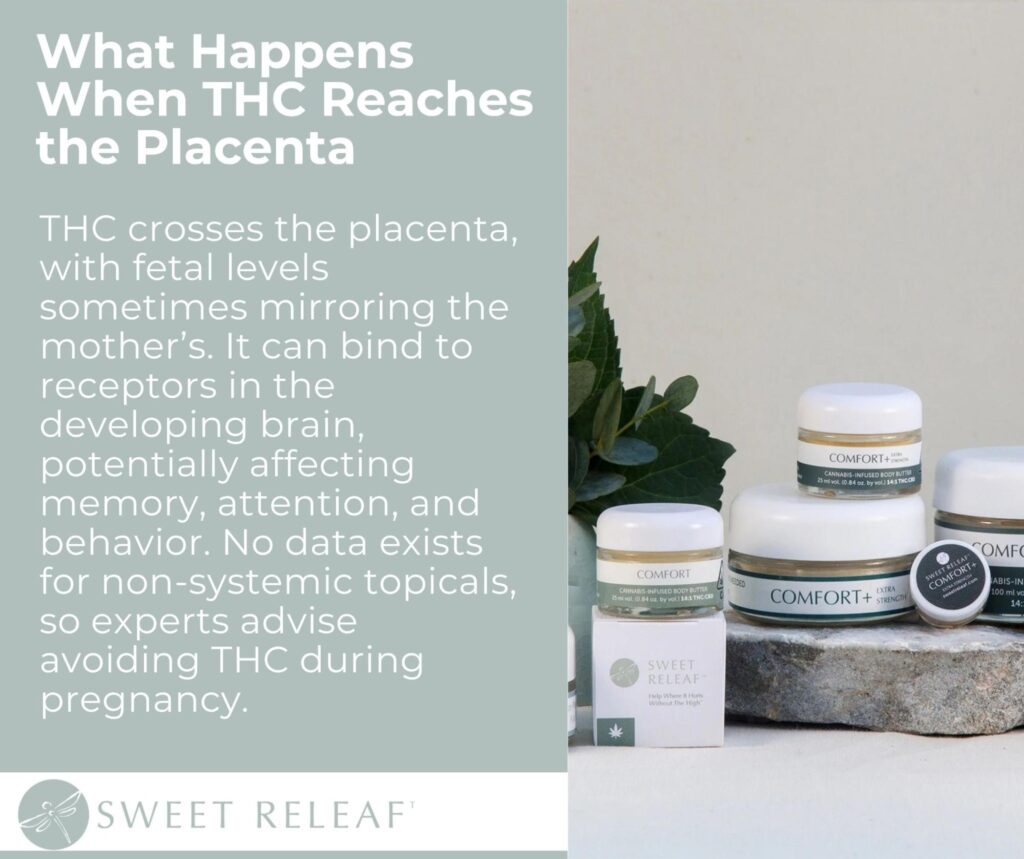
THC is a small, fat-soluble molecule, which makes it highly efficient at crossing biological barriers, including the placenta.
Both animal and human studies confirm that when THC is present in the mother’s bloodstream, it can pass into the fetal circulation.
In some cases, fetal THC levels closely mirror those in maternal blood.
Once in the fetal system, THC can bind to cannabinoid receptors in the developing brain and nervous system.
Research has linked prenatal exposure to possible long-term changes in attention span, memory, problem-solving ability, and behavior.
These effects may not be obvious at birth but can emerge later in childhood.
What we don’t know is only as important: there are currently no human studies measuring fetal exposure from non-systemic, local-only topical THC products.
Without that data, experts can’t definitively say whether such use is completely safe, especially given the possibility of product mislabeling or accidental systemic absorption.
Because of these uncertainties, health agencies default to the precautionary principle: if THC can enter the bloodstream in any amount, it should be avoided during pregnancy to eliminate potential risk to the baby.
Legal & Testing Concerns
For many expectant parents, the medical risks of THC are only part of the equation; legal and hospital policies can create serious consequences even when cannabis use is minimal or localized to the skin.
Hospital drug testing
Some hospitals have policies that include routine drug screening for mothers and newborns, sometimes without explicit consent.
These policies vary by state, hospital system, and even individual providers. It’s important to ask your care team ahead of time what their screening procedures are.
Potential CPS involvement
If a newborn’s test comes back positive for THC, Child Protective Services (CPS) may be notified, even if cannabis is legal in your state and even if the exposure came from a topical product.
The involvement can range from a brief interview to a formal investigation, and outcomes differ widely by jurisdiction.
Meconium testing window
Newborn meconium (the first stool) can reveal cannabis exposure from mid-pregnancy onward, often capturing a four- to five-month history.
This means that even occasional use earlier in pregnancy could appear on the test results.
Because of these potential legal and social consequences, many healthcare providers recommend avoiding all cannabis products during pregnancy, including topicals, until you can be certain of a product’s contents, formulation type, and your local testing laws.
Safer Alternatives for Pain in Pregnancy
If you’re managing pain during pregnancy, there are several non-cannabis options that can offer relief without the potential medical or legal concerns tied to THC.
Always confirm safety with your OB or midwife before starting any new therapy.
Non-cannabis topicals
- Menthol-based creams and gels can provide a cooling sensation that eases muscle tension and minor joint pain.
- Camphor formulations may help with localized aches, but dosage and concentration should be reviewed by a healthcare provider.
- Arnica creams or gels are sometimes used for bruising and soreness, though their use in pregnancy should be discussed with your care team.
Therapeutic approaches
- Physical therapy can address underlying issues causing pain, improve posture, and strengthen supporting muscles.
- Heat or cold packs can be applied for short periods to reduce inflammation or relax tight muscles.
- Prenatal massage (performed by a trained therapist) can improve circulation, decrease swelling, and relieve back and hip discomfort.
Relaxation and at-home care
- Magnesium baths (using Epsom salts) may help ease muscle cramps and promote relaxation.
- Guided relaxation or prenatal yoga can lower muscle tension, improve flexibility, and reduce stress-related discomfort.
Exploring these alternatives can help you stay comfortable while avoiding both the known and unknown risks of THC during pregnancy.
Sweet Releaf’s Perspective & Products
I understand why so many expectant parents start searching for answers about topical THC.
When pain is stealing your sleep, slowing your day, or making it harder to enjoy your pregnancy, it’s natural to want relief, and to want it without the “high.”
Our THC-forward topicals are designed for deep, lasting relief from chronic pain, arthritis, post-surgery soreness, and more.
They work by penetrating deep into the skin and muscle tissue without psychoactive effects, but out of caution, and because the research is not there yet, we do not recommend using them during pregnancy.
For the postpartum period (once your provider gives you the all-clear), our customers have found our products invaluable for regaining comfort and mobility:
- Comfort+ Extra Strength Body Butter – Deep-penetrating, non-psychoactive relief for stubborn aches.
- Comfort Cools Roll-On – A refreshing, cooling sensation to ease tight or overworked muscles.
- Comfort Warms Roll-On – Gentle warmth that melts away stiffness and promotes relaxation.
Our emulsion base means faster absorption, no greasy residue, and scents people actually enjoy using day after day.
Over the years, we’ve heard from parents, athletes, gardeners, and chronic pain survivors who’ve used our products to reclaim their comfort and their lives.
When the time is right, you can shop our collection for yourself, or gift it to someone you love who needs safe, effective, plant-based relief.
Key Takeaways
- No definitive safety data means the safest choice is to avoid THC during pregnancy, even in topical form, until research can confirm it’s risk-free.
- If you decide to use any cannabis topical, make sure it is non-transdermal, has verified THC content from third-party lab testing, and is approved by your OB or midwife.
- Always weigh the relief you’re seeking against possible health impacts, legal implications, and hospital testing policies that could affect you and your baby.
Pain management in pregnancy is about finding comfort without compromise, and when it comes to THC, that means leaning on safer alternatives now so you can confidently enjoy the relief you love later.
Common Questions Answered
What happens when you use THC while pregnant?
If THC enters your bloodstream, it can cross the placenta and potentially expose your baby to cannabinoids during critical stages of development.
Research links prenatal exposure to risks like low birth weight and possible long-term impacts on attention, memory, and behavior.
Systemic delivery routes, such as smoking, edibles, vaping, or transdermal products, carry the highest concern.
Does THC reduce pregnancy chances?
Human data is limited and inconsistent, but some animal studies suggest that high doses of THC may interfere with reproductive hormones, ovulation, and implantation.
While the effects in humans aren’t fully understood, medical authorities still advise avoiding cannabis when trying to conceive.
Can I use topical THC while pregnant?
The medical consensus is to avoid any cannabis product during pregnancy out of caution.
However, non-systemic topicals, those that act only on the skin and muscles without entering the bloodstream, are theoretically lower risk.
The challenge is confirming your product’s formulation and ensuring there’s no unintended systemic absorption or THC content from mislabeling.
Always discuss with your doctor before use.
How does THC affect the placenta?
THC crosses into fetal circulation and may alter placental function, potentially affecting nutrient and oxygen delivery.
It can also bind to cannabinoid receptors in fetal tissues, which may influence brain development and growth patterns.