
Cannabis topicals can reduce back pain by delivering cannabinoids like THC and CBD directly to affected tissues. Studies and user reports show they help ease inflammation and nerve-related discomfort without psychoactive effects, making them a safe, localized option.
Some People Doubt Cannabis When It Comes to Pain. We Don’t
Plenty of folks, including doctors, will ask: “Does cannabis actually relieve pain, or is it just a comforting story people tell themselves?”
We’ve heard this question more times than we can count, and we respect where it comes from. Pain science is complex. Chronic pain, even more so. And cannabis still carries the weight of decades of misunderstanding.
But something’s shifting. We’re seeing a steady rise in patients who’ve tried everything from prescription meds to physical therapy with limited success, only to find real relief through cannabis topicals.
Topical THC doesn’t need to enter your bloodstream to do its job. It interacts with cannabinoid receptors in your skin, muscles, and fascia. That means it can work directly where the discomfort lives without affecting your headspace.
Here’s what a well-made THC cream can do:
- Reduces inflammation at the source of the pain
- Interrupts pain signaling at the skin and nerve level
- Soothes muscle tension and spasms
- Doesn’t enter the bloodstream
- Compatible with daytime use, driving, and work
- Safe to reapply throughout the day
Sweet Releaf has been making THC-forward, full-spectrum cannabis topicals for over a decade, including our signature emulsion body butters and Ayurvedic roll-ons. We make them strong, non-psychoactive, and always full-spectrum, because that’s what actually works.

If back pain has been calling the shots lately, keep reading. There’s a lot more to know.
Let’s Talk About Back Pain
Your lower back can hurt for mechanical reasons, inflammation, nerve impingement, or a variety of causes that shifts day to day. That mix explains why one-size solutions so often disappoint. Here’s how the most stubborn patterns usually show up, and why they can be so hard to settle.
Types of Back Pain That Don’t Let Go
Most persistent cases fall into a few buckets, even when the symptoms overlap. You’ll hear these described in plain language, yet they map to real physiology:
- Chronic lower back pain from disc issues such as herniation or degeneration, where irritated tissue and protective muscle guarding keep the area sensitive
- Post-surgical pain or scarring, where dense tissue and heightened nerve endings can make recovery feel unfinished
- Muscle tension from stress or poor posture, where tight muscles and fascia reduce ease of movement and keep pulling on the same sore spots
- Nerve pain from spinal stenosis or sciatica, where compression or irritation can send pain into the hip, buttock, or leg
When someone asks me whether a topical can help, this is the first question I’m really asking: which pain story is their body telling today?
The Daily Toll
Persistent pain changes behavior first, then biology. People stop twisting, lifting, walking, and training because each movement carries a penalty. Sleep turns light because rolling over triggers a flare. Less movement means weaker support muscles and stiffer joints, which can make the next day feel even tighter.
The mind pays for it too. When discomfort keeps tugging at your attention, patience gets shorter and focus gets thin. That wear-and-tear feeling becomes part of the condition, not just a reaction to it.
Mainstream Treatments and Why They Fall Short
A lot of conventional treatment options aim for broad, whole-body dampening.
Opioids can blunt severe pain, yet many people feel mentally dulled and worry about dependence. NSAIDs can calm inflammation, yet frequent use can be rough on the gastrointestinal tract. Muscle relaxers may reduce spasms, yet grogginess can steal the very productivity and clarity people are trying to protect.
That’s why “I’ve tried everything” is such a familiar line.
Many treatments address pain perception or inflammation system-wide, while the sore tissue in the low back still needs targeted care, daily function, and a way to calm the local pain signaling without stealing your day.
What Cannabinoids Actually Do for Back Pain
Back pain involves two primary biological processes: heightened pain signaling and localized inflammation. Cannabinoids influence both through the body’s endocannabinoid system, a regulatory network present in the skin, nerves, connective tissue, and immune cells.
CB1 and CB2 Receptors: Nature’s Pain Gatekeepers
CB1 receptors are located along peripheral nerves and in the central nervous system. In the context of back pain, peripheral CB1 receptors play a key role in modulating nociception, the transmission of pain signals from tissue to brain. When activated, these receptors can reduce the intensity of incoming pain signals before they escalate.
CB2 receptors are concentrated on immune cells and are heavily involved in inflammatory regulation. When tissue is injured or irritated, immune activity increases, releasing cytokines and other inflammatory mediators. Activation of CB2 receptors helps temper that response, reducing localized inflammation and secondary nerve sensitization.
In chronic lower back pain, especially cases involving disc irritation, muscular strain, or nerve compression, both signaling pathways are often active simultaneously. That dual involvement makes cannabinoid interaction biologically relevant.
How Topical THC Interacts with These Receptors
When THC is applied topically in a properly formulated base, it binds to cannabinoid receptors in the skin and underlying tissues without entering the bloodstream in significant amounts. Standard topical formulations do not cross into systemic circulation at levels associated with psychoactive effects.
This localized action distinguishes creams and emulsions from inhaled or ingested cannabis. Inhalation produces central nervous system effects because cannabinoids circulate widely. Topicals act at the site of application.
That allows targeted tissue interaction without cognitive alteration.
Onset time varies depending on formulation and tissue depth, though many users report perceivable changes within minutes, particularly in muscle-dominant pain patterns.

What the Research Shows
Preclinical research demonstrates that cannabinoids reduce inflammatory and neuropathic pain behaviors in animal models, including arthritis-related joint pain.
Human studies examining cannabis for back pain report measurable reductions in pain intensity with generally acceptable short-term safety profiles.
A systematic review of controlled studies found that most trials showed statistically significant improvement compared to placebo, though sample sizes were modest and long-term follow-up remains limited.
Clinical literature continues to evolve, but current evidence supports a biologically plausible analgesic effect, especially in inflammatory and neuropathic contexts.
Why CBD Alone Often Produces Limited Results
CBD has documented anti-inflammatory and anxiolytic properties. It can support sleep quality and reduce stress-related muscle tension. However, CBD has minimal direct agonist activity at CB1 receptors. Without meaningful CB1 activation, modulation of peripheral pain signaling may be limited in more severe or nerve-related back pain.
Products containing both THC and CBD, particularly full-spectrum formulations, engage multiple receptor pathways simultaneously. Many patients who report minimal response to CBD-only creams describe more noticeable relief when THC is present in sufficient concentration.
That difference aligns with current pharmacological understanding of cannabinoid receptor activation rather than anecdote alone.
Are Cannabis Topicals the Right Choice for Your Back Pain?
Choosing a treatment for back pain usually comes down to trade-offs. Relief on one side, side effects on the other. Many people tolerate foggy thinking, digestive irritation, or fatigue because the pain feels worse. A topical shifts that equation by working locally instead of system-wide.
Targeted Treatment Without the Side Effects
A properly formulated cannabis topical is applied directly to the sore area. The cannabinoids interact with receptors in the skin, fascia, and muscle underneath that exact spot. The rest of the body stays largely uninvolved.
Because standard topicals do not enter the bloodstream in significant amounts, they do not place measurable strain on the liver, kidneys, or gastrointestinal tract. That makes them appealing for people who already take medications and want to avoid stacking systemic effects.
For someone managing chronic lower back pain alongside other health considerations, that localized approach can feel like a practical adjustment rather than a major intervention.
Daytime-Friendly Relief
Many people with persistent back pain are still working, driving, caring for family, or teaching classes. A topical containing THC, when used externally, does not produce intoxication because it acts on peripheral receptors rather than the brain.
Users routinely describe being able to apply it before a long meeting or commute without any change in alertness. One customer told us his father applies it before heading to campus to lecture and notices reduced stiffness without any mental haze.
That combination of comfort and cognitive steadiness is part of why topicals appeal to older adults and professionals who want relief without altering their headspace.
All Day or Night Only, Your Choice
Another advantage is flexibility. Some people apply a topical in the morning to loosen tight muscles before activity. Others reserve it for the evening, massaging it into the lower back before bed to reduce nighttime discomfort and improve sleep continuity.
Reapplication is straightforward, and many users find that consistent use over days or weeks produces steadier baseline comfort.
For pain that fluctuates throughout the day, having a tool that can be used when and where it is needed gives people back a sense of control.

What Kind of Cannabis Topical Works for Back Pain?
Once you accept that cannabinoids can influence pain signaling locally, the real decision becomes practical. What strength makes sense for your kind of back pain? And what delivery format actually gets the cannabinoids where they need to go?
Lower back pain that has lingered for months rarely responds to mild formulations. Ratio and base matter more than most people realize.
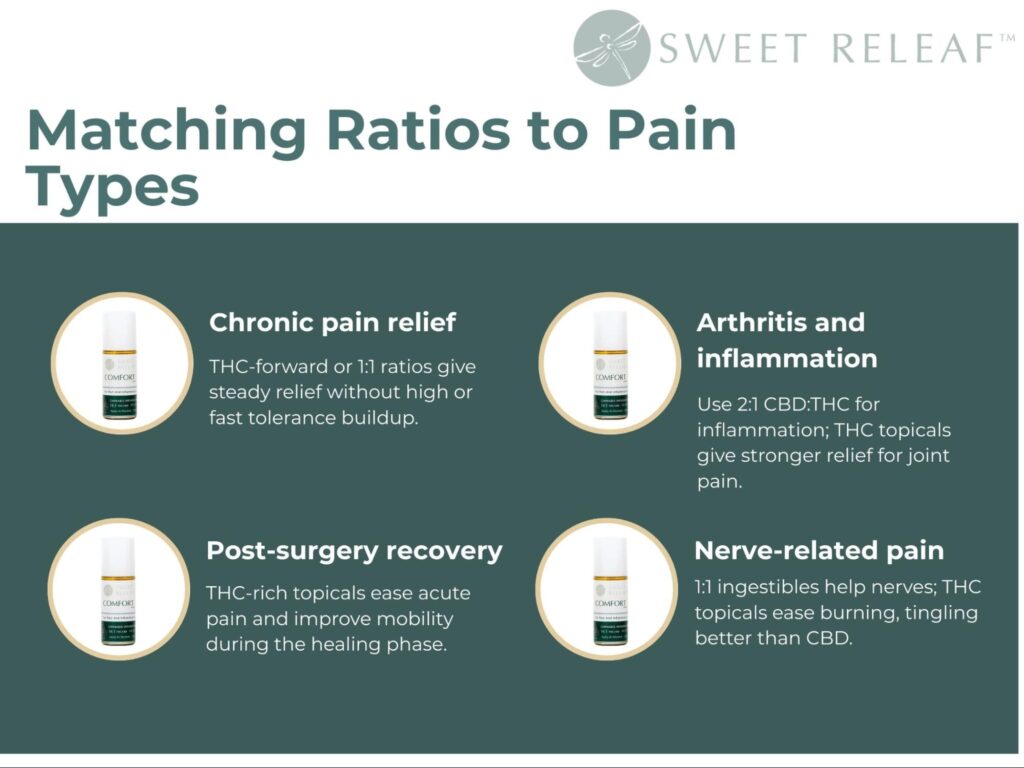
Understanding THC:CBD Ratios
Different ratios shift how a topical behaves in tissue.
- CBD-dominant formulas: These lean toward anti-inflammatory support. They may help mild muscle fatigue or post-exercise soreness. For deeper disc-related or nerve-driven pain, many users report very subtle results.
- Balanced 1:1 THC:CBD formulas: These provide a moderate, well-rounded effect. Suitable for recurring muscle tightness and moderate lower back strain. For severe or radiating pain, they can feel underpowered.
- THC-dominant formulas: More appropriate for persistent lumbar pain, post-surgical sensitivity, or sciatica. Stronger peripheral CB1 engagement supports more noticeable modulation of localized pain signaling.
People who describe trying a cream that “did nothing” are often using low-THC or isolate-based products. Full-spectrum, THC-forward formulations tend to behave differently because they engage multiple cannabinoid pathways simultaneously.
Why Format Matters: Cream vs. Salve vs. Emulsion
Potency alone does not guarantee performance. The structure of the base determines how well cannabinoids disperse and absorb.
Traditional wax-heavy salves often remain near the surface. They can feel soothing yet may not efficiently reach deeper muscle and fascial layers of the lumbar region. An emulsion blends oil and water phases in a way that allows cannabinoids to move more evenly into tissue.
This is where Sweet Releaf’s approach stands apart. Our body butters are formulated as true emulsions, not simple oil-and-wax balms. That design supports deeper penetration, consistent absorption, and a clean finish that does not leave a heavy film on clothing or skin.
For chronic lower back pain, comfort and absorption need to coexist. A product that feels good but sits on top of the skin will not satisfy someone dealing with disc irritation or nerve tension.
Top Sweet Releaf Products for Back Pain Relief
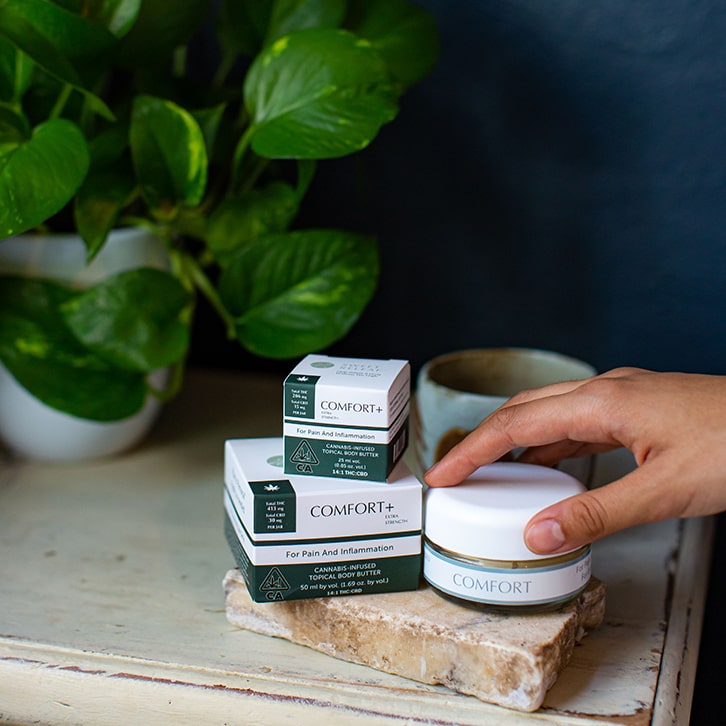
- Comfort+ Extra Strength Body Butter: A THC-forward, full-spectrum emulsion developed for chronic, structural, and post-surgical back pain. Designed for deeper tissue interaction with a smooth, non-greasy finish suitable for daily use.

2. Comfort Warms Dry Oil Roll-On: A warming, Ayurvedic-inspired roll-on ideal for tight lumbar muscles and nerve tension. The applicator allows precise placement along the lower spine and hips while delivering concentrated cannabinoid support.

How to Use a Topical for Back Pain
Application matters more than most people realize. A well-formulated topical can underperform if it is rushed onto the skin or layered over other products. The goal is simple: give the cannabinoids clear access to the tissue that needs support.
Follow these steps for consistent results:
- Clean the area.
Wash or wipe the lower back to remove sweat, dirt, or leftover lotion. Residue can interfere with absorption and reduce contact with the skin. - Apply a generous amount.
The lumbar region contains thick muscle and fascia. A light smear rarely reaches deep enough. Use enough to cover the affected area fully. - Massage it in slowly.
Gentle, steady pressure helps increase local circulation and supports penetration into muscle layers. Take your time rather than rushing through it. - Allow 10 to 15 minutes.
Many people begin to notice a shift within this window, especially with THC-forward emulsions designed for deeper absorption. - Reapply as needed.
For chronic conditions, two to three applications per day is typical. Consistent use often produces steadier relief over time.
If back pain interferes with sleep, apply before bed and allow the tissue to settle as the body transitions into rest.
Don’t Stick with Imperfect Solutions, Try Relief That Works
Living with back pain can make you feel like you’ve aged a decade overnight. When every movement hurts, it’s easy to start shrinking your life. You say no to hikes, long drives, picking up your grandkid.
But pain doesn’t have to be the full stop. Sometimes, it’s just a comma.
Cannabis topicals can give you back the freedom to move without making you feel medicated, especially when formulated with real THC, whole-plant medicine, and intelligent design.
They don’t fog your brain, they don’t knock you out, and they don’t pretend to be miracle cures. But when they work, they work.
If you’ve been burned by weak CBD creams or overwhelmed by pharma side effects, this is your nudge to try something that meets your body where it hurts. Sweet Releaf can provide you with functional THC topicals that your back will be thrilled to meet.
👉 Find our products at a retailer near you or ask us any question that might be on your mind.