
Topical THC can help knee pain by reducing localized inflammation and interacting with cannabinoid receptors in the skin. Evidence is limited but suggests potential benefit for arthritis, overuse injuries, and joint discomfort when topicals are dosed and applied the right way.
New Solution for a Chronic Problem
Knee pain creeps up on you. It starts with a twinge on the stairs, then a hesitation before a long walk, then a quiet calculation before committing to anything that requires standing too long.
The joint itself is built to carry you through decades of movement, yet once inflammation takes hold inside that tight capsule, relief can feel frustratingly out of reach.
Part of the challenge is structural. Cartilage receives very little direct blood flow, so healing moves slowly. Swelling inside the joint increases pressure and heightens pain signaling.
Oral anti-inflammatories circulate through the entire body to reach one irritated knee, often bringing digestive strain or long-term risks along for the ride. Many over-the-counter creams offer a cooling sensation on the surface but never meaningfully interact with the tissue that is actually inflamed.
THC topicals offer a different approach. Applied directly to the knee, they may:
- Reduce localized inflammation
- Calm amplified pain signaling
- Relax protective muscle tension around the joint
- Support smoother, more confident movement
- Provide relief without intoxication
Cannabinoid receptors are present in skin, connective tissue, and immune cells near the joint. A high-THC, full-spectrum topical can interact with those receptors locally, keeping effects focused where they are needed.
Sweet Releaf has built its reputation on crafting non-psychoactive, high-THC body butters designed for real joint pain, especially for people who tried low-potency CBD creams and felt little change.

What follows explores how cannabinoids work, what research shows so far, which knee conditions respond best, and how to use THC topicals in a way that supports lasting mobility.
How Cannabinoids Relieve Joint Pain
Knee pain is driven as much by chemistry as it is by mechanics. Inflamed synovial tissue releases cytokines that sensitize local nerves. Peripheral nerves amplify the signal. Surrounding muscles tighten to stabilize the joint, which further restricts movement.
Cannabinoids interact with this inflammatory and neural cascade at several points, which explains why topical application has become increasingly relevant in joint management.
The Pain-Relieving Properties of THC
THC binds to CB1 and CB2 receptors found in skin, connective tissue, peripheral nerves, and immune cells. CB1 receptors influence nociception, or how pain signals are transmitted. CB2 receptors regulate inflammatory signaling and immune cell behavior within affected tissue. Both receptor types are present around synovial joints, including the knee.
When THC is applied topically, it interacts locally with these receptors, modulating inflammatory mediators and dampening overactive pain signaling in the tissue surrounding the joint.
Since topicals remain localized within superficial and periarticular tissue, systemic absorption is negligible. Blood concentrations remain too low to produce psychoactive effects. Standard topical THC creams do not cause intoxication, cognitive impairment, or functional limitation during daytime use unless specifically engineered as transdermal systems.
Current Research on Cannabis and Knee Pain
Large randomized trials focused exclusively on THC topicals for knee osteoarthritis remain limited, but foundational research supports the biological plausibility.
A 2016 study evaluated transdermal cannabidiol in an animal model of arthritis and demonstrated significant reductions in joint swelling and inflammatory biomarkers without observable side effects. The findings support localized cannabinoid modulation of joint inflammation.
In humans, a 2020 randomized, placebo-controlled trial examined topical CBD in patients with peripheral neuropathy and found statistically significant reductions in intense pain and cold sensations compared to placebo. Although the condition differed from knee osteoarthritis, the study confirmed that topical cannabinoids can meaningfully influence peripheral pain pathways.
What most studies do not address is potency. Research often evaluates low-dose hemp-derived preparations and rarely compares them to higher concentration, full-spectrum THC formulations.
That distinction may significantly affect clinical outcomes, yet remains underexplored.
Advantages Over Traditional Pain Medications
For chronic knee pain, long-term reliance on NSAIDs and opioids carries well-documented physiological trade-offs.
NSAIDs place sustained stress on the gastrointestinal tract, kidneys, and cardiovascular system. Opioids alter central pain processing and carry clear dependency risk. Oral THC products affect cognition and reaction time because they circulate systemically.
Compared to systemic pain medications, topical THC offers:
- No measurable liver enzyme burden
- No kidney strain associated with chronic NSAID use
- No dependency risk
- No systemic sedation
- No gastrointestinal irritation
- No tolerance escalation pattern typical of oral THC
Many individuals who transition to topical cannabis describe doing so after years of rotating between ibuprofen and prescription analgesics. The goal is local modulation of inflammation and peripheral nerve sensitivity while preserving mental clarity and organ health.

Why Topical THC Is Especially Well-Suited for Knee Pain
The knee is a superficial, load-bearing joint with clear anatomical access points. That accessibility changes how topical therapies perform.
Unlike hip pain, which sits beneath thick muscle layers, knee discomfort often involves structures closer to the surface, including the joint capsule, collateral ligaments, and surrounding connective tissue.
This is why saturation of skin-based receptors is enough to reduce inflammation and improve the subjective feeling to a considerable degree.
Topicals vs. Transdermals
A standard topical THC cream is designed to remain localized. It acts within the skin and superficial periarticular tissue and does not enter systemic circulation in meaningful amounts. That localized action allows modulation of inflammatory signaling and peripheral nerve sensitivity without cognitive or psychoactive effects.
Transdermal products serve a different pharmacologic purpose. They are engineered to move cannabinoids across the skin barrier into the bloodstream, creating systemic exposure and potentially central effects.
For knee pain management, most individuals are seeking targeted relief that supports mobility without significant side effects. Localized topical application aligns with that goal, especially when the formulation is designed for meaningful tissue penetration rather than surface sensation alone.
Which Knee Conditions Respond Best to THC Topicals?
The effectiveness of THC topicals is not uniform across every type of knee pain. The source of inflammation, the depth of tissue involvement, and the chronicity of the condition all influence the extent of the cream’s impact.
Topicals tend to perform best when inflammation and nerve sensitivity are localized around the joint capsule and surrounding soft tissue rather than deep structural instability.
Daily Wear-and-Tear
This is the slow accumulation pattern. The joint has not failed. It has simply absorbed decades of load. The cartilage thins gradually, the synovial lining becomes reactive, and stiffness builds after inactivity.
You’ll see it in situations like:
- Climbing stairs after sitting
- Stiffness first thing in the morning
- Swelling after a long walk
- Aching after a day on your feet
In this setting, a high-quality THC topical can reduce low-grade inflammatory signaling in the tissue surrounding the joint capsule.
By calming peripheral nerve sensitivity and easing protective muscle tension, movement often feels smoother and more fluid. It does not reverse structural change, but it can lower the inflammatory background noise.
Overuse Irritation
This pattern shows up in active people who ask a lot of their knees. The joint itself is structurally sound, but repetitive loading creates predictable inflammatory flare cycles.
Common triggers include:
- Long runs
- Repeated squatting
- Gardening or yard work
- Standing on hard surfaces for hours
Here, topical THC is typically applied after activity to moderate post-load inflammation.
By interacting with CB receptors in local connective tissue, it may reduce the next-day stiffness that follows cumulative strain. Relief can be noticeable, but it works best when paired with intelligent recovery rather than increased output.
Acute Traumatic Strain
A twist, a misstep, or a fall can irritate ligaments and soft tissue around the knee. Swelling increases quickly, and surrounding muscles tighten to protect the joint.
Conditions that fit this description might include:
- Minor ligament sprains
- Swelling after impact
- Post-procedure soreness with medical clearance
In these cases, THC topicals function as supportive care. Local receptor engagement may help modulate inflammatory mediators while easing muscular guarding around the joint.
They do not replace structural repair or rehabilitation, but they can improve comfort during the recovery window when used appropriately.
Chronic Degenerative Joint Disease
In osteoarthritis, structural cartilage loss is layered with persistent synovial inflammation. Much of the daily ache comes from inflammatory amplification rather than bone mechanics alone.
Typical features include:
- Persistent baseline aching
- Swelling during flare periods
- Reduced tolerance for sustained activity
- Increased discomfort in cold weather
Higher-potency THC formulations tend to perform better in this category because receptor engagement must compete with ongoing inflammatory signaling.
While cartilage cannot be rebuilt by applying a topical cream, reducing inflammatory tone around the joint can extend functional comfort and improve tolerance for daily movement across several hours at a time.

What Makes the Best THC Cream for Knee Pain?
Knee pain places specific demands on a topical formulation. The tissue surrounding the joint capsule is dense, vascular, and often chronically inflamed.
A product designed primarily for skin hydration will not perform the same way as one engineered for receptor-level interaction in periarticular tissue.
Potency, cannabinoid profile, and delivery system determine whether the cream produces measurable functional change or a temporary surface effect.
Why High-THC Formulations Work Better
Joint inflammation requires sufficient cannabinoid concentration to meaningfully engage CB1 and CB2 receptors in connective tissue and immune cells. When THC levels are low, receptor activation may be too limited to influence inflammatory signaling beyond a mild sensory effect.
Higher THC concentration increases the likelihood of sustained receptor interaction in the tissue surrounding the knee. That deeper engagement can support more consistent modulation of inflammatory mediators and peripheral nerve sensitivity.
In practice, individuals using higher-potency formulations often report longer intervals between applications and steadier comfort throughout the day. For chronic or degenerative knee conditions, concentration frequently determines whether the topical feels therapeutic.
Sweet Releaf Does Things Differently
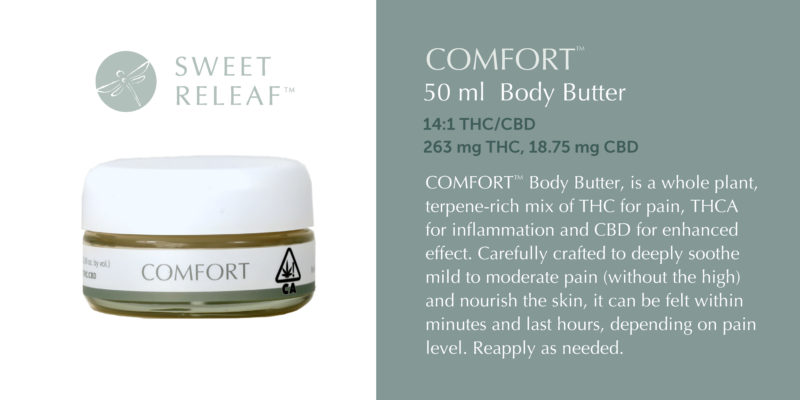
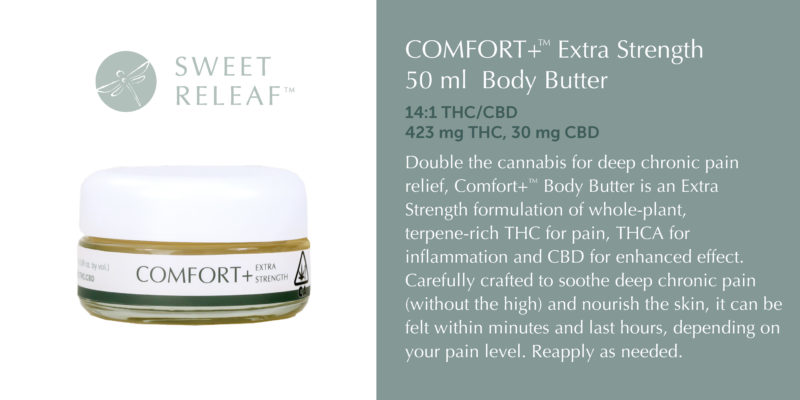
Sweet Releaf formulates with whole-plant, full-spectrum cannabis rather than isolates or distillates. The presence of Delta-9 THC at meaningful concentrations is supported by the broader cannabinoid and terpene profile of the plant.
The base is an emulsion, combining oil and water phases to enhance absorption compared to wax-heavy salves that sit on the surface.
Aloe vera contributes to tissue penetration, and the formulas exclude synthetic preservatives that dilute active concentration. The emulsion texture allows the product to absorb quickly without leaving residue. For knee application, that practical detail matters when the cream is used before dressing, before activity, or during a workday.
Recommended Products for Knee Pain
How to Get the Most Out of THC Topicals for Knee Pain
The knee is a compact joint surrounded by dense connective tissue and a tight capsule that traps inflammation when it builds. A topical works at the level of the skin and the tissue just beneath it, so placement and consistency determine whether cannabinoids meaningfully interact with irritated areas around the joint.
Used with a clear plan, a high-THC cream can steady flare cycles and support smoother movement throughout the day.
Occasional “Emergency” Use
Knee pain often spikes after overexertion, long periods of travel, or sudden increases in activity. Swelling may rise quickly, and stiffness can make basic movement uncomfortable.
In these moments, apply a generous layer directly over the joint line and slightly above and below the kneecap. Massage for thirty to sixty seconds to encourage absorption into surrounding tissue.
Reapplication every four to six hours can help stabilize inflammation during the flare period. This approach is intended to calm a temporary surge rather than manage long-term patterns.
Daily Pain Management
Chronic knee discomfort responds best to steady input rather than reactive use. Inflammation that lingers in the synovial lining tends to resurface if receptor engagement is inconsistent.
Applying the cream in the morning and again in the evening helps create a predictable baseline. Work it along the joint line, into the sides of the knee, and into the soft tissue behind the joint where tightness often concentrates.
Light mobility exercises afterward can improve circulation and support distribution. Regular, moderate use typically produces more stable relief than occasional heavy application.
How Much Should You Use?
There is no universal dose because tissue density, inflammation level, and product potency are all case-specific.
A practical starting point is a nickel-sized amount for one knee. If relief feels limited, increase gradually over several days rather than doubling the amount at once. Most individuals report effects lasting between two and six hours.
When relief fades within twenty to thirty minutes, the formulation may be underpowered for the level of inflammation present, and a higher-potency option may be more appropriate.
Keeping Your Knees Working Smoothly
The right topical won’t rebuild cartilage overnight, but it can quiet inflammation just enough to let you move again. For someone struggling with knee pain daily, that small victory is worthy of a celebration.
If you’ve tried CBD creams and felt nothing, it may not be cannabis that failed you. You simply may not have discovered the right cream for the type of use you have in mind. .
If you’re curious whether high-THC, non-psychoactive topicals can make a difference for your knees, Sweet Releaf offers formulations designed specifically for real joint pain.
We would be happy to tell you more about them if you ask us directly.