
People prefer Ayurvedic treatments for their focus on root-cause healing, personalized care, and plant-based remedies with fewer side effects.
As interest grows, modern solutions like Sweet Releaf’s THC topicals offer similar natural relief, delivering targeted results without the high or systemic impact.
Ayurveda At Its Core: How It Really Works

Ayurveda gets talked about as “natural” or “ancient,” but that doesn’t really capture what it feels like to live by it. At its core, it’s about balance, the idea that your body isn’t broken, it’s communicating.
And if you pay attention, you can start to understand what it’s asking for.
It works through a simple but powerful lens: everyone is different. Your digestion, stress response, energy, and tolerance all vary, and Ayurveda builds around that.
It also puts digestion at the center, not just food, but how you process stress, eмоtions, and daily life.
More than anything, Ayurveda is about rhythm. Daily habits, seasonal shifts, sleep, and movement all work together to keep you steady.
That’s why most people don’t come to Ayurveda out of curiosity, they come because something else didn’t work.
Why Do People Prefer Ayurvedic Treatments?
People prefer Ayurvedic treatments because they offer a different way of thinking about health, one that looks beyond symptoms and focuses on balance, routine, and root causes.
For those tired of quick fixes and recurring issues, Ayurveda feels more personal, more natural, and often more aligned with how the body actually works.
1. It Focuses On The Root Cause, Not Just Symptoms
Most people aren’t frustrated by pain itself, they’re frustrated because it keeps coming back. Ayurveda leans into that, asking why the issue started instead of just how to stop it.
That shift matters, especially for chronic patterns like recurring joint pain or digestion issues.
The trade-off is time. Results aren’t always immediate, and progress can feel uneven.
But for many, it’s the first time someone is trying to understand the pattern, not just silence the symptom.
2. Personalized Wellness Feels More Human
Ayurveda doesn’t hand you a standard plan, it asks questions. How you sleep, eat, handle stress, and move all shape the approach.
That level of attention makes people feel seen, not processed.
Sometimes the journey starts through family influence, not personal choice. But that trust often opens the door, and for some, it turns into something that genuinely helps.
3. Natural, Plant-Based Remedies (But Not Always Risk-Free)
There’s a strong pull toward plant-based care, herbs, oils, massage, and detox therapies feel less aggressive than pharmaceuticals.
For people tired of side effects, that alone is a reason to explore Ayurveda.
But “natural” isn’t automatically safe. Quality, sourcing, and preparation matter, and not all products meet the same standard.
The benefit comes with responsibility, choosing the right practitioner or formulation.
4. Prevention Over Reaction
Ayurveda is built on the idea that it’s easier to stay balanced than fix imbalance later.
That shows up in daily habits, eating regularly, adjusting to seasons, supporting digestion before problems start.
It’s not fast or flashy. But for people burned out on short-term fixes, this slower, steadier approach starts to feel more reliable.
5. A Holistic Mind-Body Approach
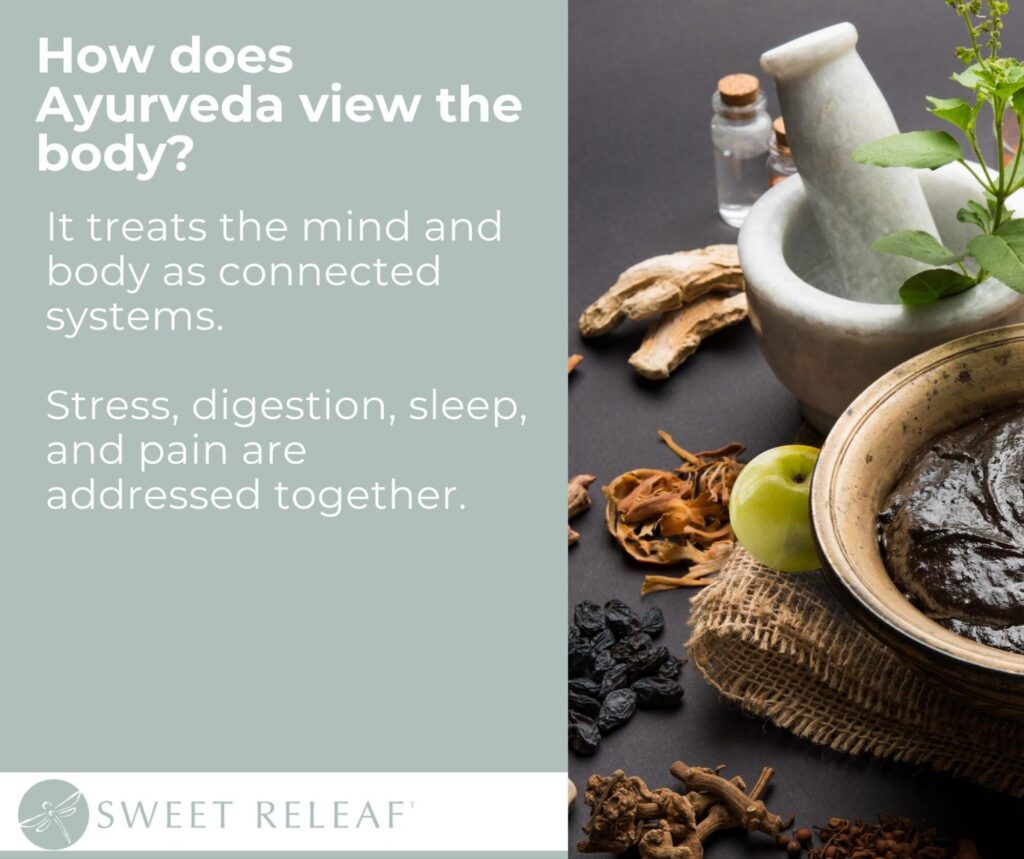
Ayurveda doesn’t separate physical symptoms from mental state. Stress, tension, digestion, and sleep are all connected, and treated that way.
The tools reflect that: yoga, breathwork, massage, and routine. It’s less about adding treatments and more about creating space for the body to regulate itself.
6. It Offers an Alternative When Conventional Care Falls Short
Many people turn to Ayurveda when they’re not in crisis, but not fully well either. Chronic pain, inflammation, and fatigue without clear answers often lead them here.
But it’s not for everything.
Ayurveda can support lifestyle issues and ongoing pain, but serious conditions still require conventional care.
The most practical approach is using both, each where it works best.
Where Ayurveda Meets Modern Cannabis
We’ve always respected Ayurveda, not because it’s ancient, but because it pays attention. It treats the body like something worth listening to, not something to override.
It looks for patterns, not just problems. And for a lot of people, that alone feels like a different kind of care.
But here’s where things start to shift.
There’s a newer wave of plant-based medicine that takes those same principles, local treatment, sensory awareness, daily rituals, and makes them more immediate.
More precise. Less abstract. That’s where cannabis topicals step in.
They don’t replace the philosophy. They translate it into something you can actually feel, right when you need it.
Why People Are Turning To Targeted Plant-Based Relief

Most people we talk to aren’t searching for another prescription. They’ve already tried that route, anti-inflammatories, muscle relaxers, daily meds that dull the pain but come with trade-offs.
Brain fog, dependency, long-term strain on the body, or just the frustration of still not feeling right.
So the shift is toward something simpler: treat the pain where it lives.
If your shoulder hurts, you shouldn’t have to medicate your entire system just to get relief. That disconnect is what pushes people to look elsewhere.
Localized relief changes the equation.
You apply it where it hurts, and the rest of your body stays out of it. It’s straightforward, but for many people, it’s the first time treatment actually feels aligned with the problem.
THC Topicals: A Modern Take On Ancient Principles
This is usually the turning point for people: realizing you can use THC without getting high. Topicals work at the surface and just below it, interacting with receptors in the skin, muscles, and joints, without entering the bloodstream in a way that affects your mind.
What that means in practice is simple.
You get targeted relief exactly where you apply it. Muscles start to loosen, inflammation settles down, and nerve discomfort eases without the mental side effects people worry about.
And the timing matters. Unlike traditional herbal routines that can take weeks of consistency, THC topicals give you feedback quickly.
Within minutes, you know if it’s helping, and that kind of immediacy builds trust.
How Topicals Mirror Ayurvedic Therapies
If you’ve ever had an Ayurvedic oil massage, this will feel familiar. It’s not just about what you apply, it’s how you apply it.
Pressure, movement, warmth, and attention all play a role in how the body responds.
Topicals follow that same structure. You massage them into the area, stimulating circulation while delivering the active ingredients.
Some formulas warm the tissue to loosen stiffness, while others cool inflammation and calm irritated areas.
Essential oils add another layer, not just scent, but function. And over time, it becomes routine.
Before bed, after a long day, post-workout, it’s less about reacting to pain and more about maintaining comfort.
Why This Hybrid Approach Appeals To Skeptical Users
There’s a certain kind of person this really resonates with. They’re open to natural approaches, but they’ve been burned before. They’ve tried products that sounded promising but didn’t deliver anything noticeable.
This hybrid approach lands differently.
It keeps the plant-based, body-aware philosophy of Ayurveda, but adds something people often feel is missing, consistency and speed. You’re not waiting weeks to guess if something is working.
Because at the end of the day, most people aren’t evaluating a philosophy.
They’re asking one simple question: Do I feel better? And when the answer shows up quickly, they don’t need much convincing to keep going.
Sweet Releaf’s Take: Bringing Ayurveda Into Real Life
When we started building these products, it wasn’t about chasing trends. It was about solving a problem we couldn’t find an answer to.
We needed something that worked on the body, not through it. Something that respected how pain shows up, localized, personal, stubborn.
And honestly, a lot of what guided us came from the same thinking you see in Ayurveda. Oils. Sensation. Routine. Whole-plant ingredients.
We just pushed it further.
Comfort Dry Oils – Warm & Cool Relief

These were designed for real life, not a spa day.
Roll them on, rub them in, get on with your day.
They absorb fast. No greasy residue. No waiting around before you can put a shirt on or get back to work.
I keep one by the bed. One in the truck. One in my pack when I’m out hiking.
That’s how they’re meant to be used.
Warm Formula (Comfort + Heat)
This one leans into heat.
If you’ve got stiffness, tight joints, that deep ache that doesn’t want to let go, this is where I start.
It mimics those warming Ayurvedic oils that bring circulation into the area. You can feel it opening things up. Muscles soften. Movement gets easier.
Great for arthritis. Old injuries. The kind of pain that’s worse when you first get moving.
Cool Formula (Relief + Recovery)
Then there’s the cooling side.
Inflammation. Overuse. That hot, irritated feeling after you’ve pushed too hard.
This formula calms things down. Takes the edge off. Lets the tissue recover instead of staying stuck in that inflamed loop.
It’s the same principle Ayurveda uses with cooling herbs, just delivered in a way that hits fast and stays local.
Why It Works for People Who Tried Everything Else
We’ve lost count of how many times we’ve heard this:
“I didn’t think it would work… but it did.”
That usually comes after someone’s tried everything, pills, creams, treatments that didn’t touch the pain.
What’s different here is simple.
- It doesn’t go through your whole system
- It doesn’t affect your mind
- It works where the pain actually is
And for a lot of people, that’s the turning point.
Especially if they’re done with pills. Done with side effects. Done with guessing.
Most of our growth hasn’t come from ads. It’s come from people handing it to someone they care about and saying, “Try this.”
That kind of trust, you don’t get that unless something actually works.
So Where Does That Leave You?

Ayurveda offers something real, a way to understand your body and step out of the cycle of chasing symptoms. For a lot of people, that shift alone is powerful.
But understanding your body and actually feeling better in it don’t always happen on the same timeline.
And when you’re dealing with daily pain, waiting isn’t always an option. You want to move freely, sleep comfortably, and get through your day without constantly thinking about it. That’s where a more immediate, localized approach starts to make sense.
If plant-based healing resonates with you, but you want something you can feel working today, that’s exactly where Sweet Releaf fits in.
The Warm Comfort Dry Oil helps loosen stiffness and tight joints, while the Cool Comfort Dry Oil calms inflammation and overworked areas. No overhaul, no learning curve, just apply it where it hurts and let your body respond.
If you’re curious, the best way to try it is to check your local dispensaries that carry Sweet Releaf and see what’s available near you.
Sometimes the next step isn’t a big decision, it’s just finding something that works, right where you are.
Disclaimer:
This article is for informational purposes only and isn’t medical advice. Sweet Releaf products are designed to support comfort, not to diagnose or treat medical conditions.
Everyone’s body is different, so results can vary. If you have a medical condition or are taking medications, it’s always a good idea to check with your healthcare provider.