Cannabis creams and lotions live in a strange space. They sit on dispensary shelves next to intoxicating products, yet they do something completely different. People hear about CBD. They hear about THC. They try one jar that does very little and decide the whole category is suspect. Clear, practical information about this format is harder to find than it should be.
Here are a few grounding facts:
- Cannabis creams and lotions work at the site where they are applied
- Most topical formulas do not create a psychoactive effect
- The concentration of cannabinoids determines whether relief is noticeable
- Full spectrum cannabis behaves differently than isolates
- The base formulation affects how deeply cannabinoids penetrate
Since 2015, Sweet Releaf has focused exclusively on high potency, whole plant cannabis topicals designed for real pain relief. Our work grew out of necessity, long before this category became fashionable. We manufacture in small batches, test every lot, and continue to refine emulsions that absorb quickly and deliver consistent results.
In the sections ahead, we will clarify how topical cannabis works in the body, what makes THC and other cannabinoids effective in this format, how legality and availability shape access, and how different types of creams and lotions perform.
What Cannabis Creams and Lotions Actually Do in the Body
Once you move past the marketing language, cannabis creams and lotions are fairly straightforward. They are designed to work where you apply them. The skin is an active organ filled with receptors, immune cells, and nerve endings that communicate constantly with the rest of the body.
A well-formulated topical works within that local system rather than traveling throughout your bloodstream.
Local Relief vs Systemic Effects
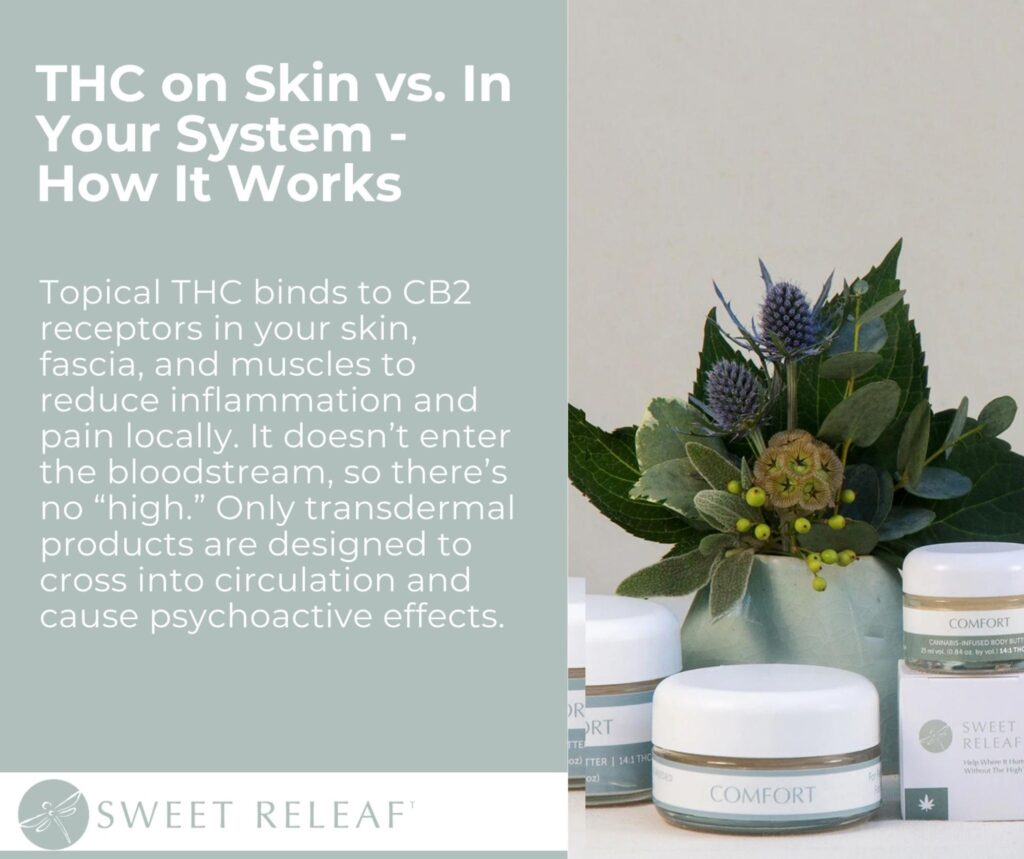
Your skin contains cannabinoid receptors, primarily CB2 receptors, along with enzymes and signaling molecules that are part of the endocannabinoid system. When a THC or full-spectrum cream is massaged into an area, those cannabinoids bind to receptors in the skin, fascia, and nearby tissues.
This interaction can influence inflammation, pain signaling, and muscle tension in a specific region where the cream is applied.
Most cannabis creams and lotions are formulated to stay within these upper and mid skin layers. They do not readily cross into the bloodstream in significant amounts. That is why people can apply a high-THC topical to a knee or shoulder and continue with their day clear headed.
Standard topical creams and lotions are designed for localized action. They do not produce intoxication because the cannabinoids are not circulating systemically in meaningful levels.
Transdermal patches are a different category. They are engineered to push cannabinoids through the skin barrier and into the bloodstream over time.
Legal Status and Availability
The legality of cannabis creams and lotions depends on the type of cannabinoids they contain and the laws of the state where they are sold.
Hemp-derived CBD topicals with less than 0.3 percent Delta 9 THC are federally legal under the 2018 Farm Bill and are widely available online and in retail stores. These products can be shipped across state lines.
THC-containing cannabis creams fall under state cannabis laws. In states such as California, where medical and adult-use cannabis are legal, THC topicals are sold through licensed dispensaries and must pass state-mandated lab testing. In states without legalized cannabis programs, THC creams are not legally available.
In short, access depends on geography and legislative details.
Where They’re Commonly Used
People reach for cannabis creams and lotions in very specific situations:
- Arthritis in hands, knees, and shoulders
- Post-surgical areas once incisions have healed and tissue is rebuilding
- Muscle soreness after physical labor or long days on your feet
- Neuropathy in feet and lower legs
- Inflammatory flare-ups tied to autoimmune conditions
- Aging-related stiffness that limits daily movement
- Pre- and post-workout recovery to support mobility and reduce tension
These use cases share one theme. The pain is local, persistent, and tied to tissue stress or inflammation. A topical meets that pain where it lives, without crossing into the bloodstream and causing any unwanted effects.
Inside Cannabinoid Content of Lotions and Creams
When people say a cannabis cream “worked” or “did nothing,” they are usually responding to cannabinoid content more than scent or texture. The plant produces dozens of active compounds, yet only a handful drive noticeable changes in pain and inflammation.
Potency and spectrum determine whether a topical delivers subtle comfort or meaningful relief.
THC: The Primary Pain Modulator
Delta 9 THC plays a central role in localized pain modulation. It binds efficiently to cannabinoid receptors in peripheral tissues and influences how pain signals are transmitted from the site of irritation to the nervous system.
In practical terms, this can translate into reduced sensitivity in inflamed joints or overworked muscles.
Topical THC also exhibits anti-inflammatory activity. It can help regulate immune signaling in irritated tissue, which is particularly relevant in arthritis and repetitive strain. Many people describe a gentle dulling of sharp discomfort combined with easier movement.
Applied to the skin in a traditional cream or lotion, THC remains localized. It does not circulate systemically in meaningful amounts, which is why a properly formulated topical does not create intoxication. Relief can be noticeable without any cognitive shift.
CBD: Supportive but Limited Alone
CBD interacts with inflammatory pathways and may help calm surface irritation. It influences cytokine activity and can support skin barrier balance. For mild soreness or temporary inflammation, CBD can provide comfort.
Chronic pain, however, often involves deeper inflammatory cascades and heightened nerve sensitivity. In these cases, CBD alone may underperform. Users frequently report short duration effects or minimal change when relying solely on hemp-derived CBD creams.
CBG and Minor Cannabinoids
Research into minor cannabinoids continues to expand. Early findings suggest supportive roles in inflammation control and muscle relaxation. These compounds appear in smaller concentrations in full-spectrum extracts and may contribute to overall performance.
Minor cannabinoids commonly found in whole-plant topicals include:
- CBG, associated with anti-inflammatory and neuromuscular effects
- CBC, linked to inflammatory modulation
- THCA, a non-intoxicating precursor that may influence inflammatory pathways
Individually, their effects may be modest. In combination, they shape the therapeutic profile.
Full Spectrum and the Entourage Effect
Full spectrum means the extract contains the full range of cannabinoids and naturally occurring compounds produced in the cannabis flower. The chemistry remains intact from the plant’s resin glands rather than being reduced to a single purified compound.
The entourage effect describes how those compounds interact together at the site of application. THC engages cannabinoid receptors in the skin and underlying tissues. Supporting cannabinoids such as CBD, CBG, and CBC influence inflammatory signaling and cellular response through their own receptor activity. Terpenes contribute additional modulation at the tissue level.
When these components remain together in their natural ratios, receptor interaction becomes layered and cooperative. Instead of one molecule acting alone, multiple compounds engage overlapping biological pathways at the same time.
Major Types of Cannabis Topicals
Once you understand how cannabinoids interact with the skin, formulation becomes the deciding factor in performance. Texture, absorption rate, and ingredient structure influence whether a topical feels cosmetic and light or dense and occlusive.
The base determines how cannabinoids move through the skin and how long the product remains active on the surface. Two jars with identical THC content can behave very differently depending on how they are built.
Cannabis Lotions
Cannabis lotions are typically thinner in consistency because they contain a higher water content relative to oils and butters. This gives them a lighter feel and allows for easy spreadability across broad areas such as the back, thighs, or shoulders. They absorb at a moderate rate and often leave a hydrated finish rather than a heavy film.
Lotions are well suited for people who want daily moisturizing combined with mild to moderate cannabinoid support. Because they spread easily, they are practical for covering larger muscle groups. Their lighter structure may limit how deeply they penetrate compared to more concentrated formats, yet they offer comfort and hydration for routine use.
Massage Creams and Balms
Massage creams and balms rely heavily on oils, waxes, and butters. Beeswax, coconut oil, and shea butter are common bases. These formulations stay on the skin longer and create more surface glide, which makes them useful for hands-on bodywork or targeted massage sessions.
Absorption tends to be slower because the oil and wax components form a more occlusive layer. The texture can feel thicker or greasier, especially in warm climates. For localized muscle knots or areas that benefit from prolonged friction and manual work, balms can provide sustained contact and controlled release.
Emulsion-Based Body Butters
Emulsion-based body butters combine oil and water into a stable cream structure. When properly formulated, this oil and water system enhances cannabinoid dispersion while maintaining a smooth cosmetic feel. The water phase helps carry active compounds into the upper and mid layers of the skin more efficiently than oil alone.
These formulations absorb faster than traditional balms and leave less residue. They often feel lighter than their richness suggests.
Creating a stable emulsion requires precise temperature control and high-shear mixing to bind oil and water into a uniform matrix. Without technical accuracy, separation occurs and the product fails. This is why well-made emulsions like the ones we make at Sweet Releaf stand apart in both performance and consistency.
Sweet Releaf’s Recommended Topicals
- Comfort Body Butter
A high-THC, full-spectrum emulsion designed for joint discomfort and long-standing inflammatory pain. The oil and water structure supports steady absorption, making it suitable for daily application and ongoing mobility support.

2. Comfort Cools Dry Oil
An Ayurvedic-inspired cooling formulation built on an MCT oil base that absorbs quickly without heavy residue. It works well during warm weather, before physical activity, or after exercise when muscles benefit from a refreshing, penetrating application.
How to Use Cannabis Creams for Best Results
Application strategy shapes results just as much as formulation. A cannabis cream can be highly potent, yet timing, consistency, and technique determine how well it performs. The body responds to rhythm. When you apply a lotion or clear with a clear plan in mind, relief becomes more predictable.
Short-Term Use
For acute flare-ups, apply the cream directly to the area at the first sign of rising discomfort. Early application can calm inflammatory signaling before it escalates. Massage the product into the tissue for at least thirty seconds to stimulate circulation and enhance absorption.
Post-exercise soreness responds well to application within an hour after activity. Muscles are warm, blood flow is elevated, and the skin absorbs readily.
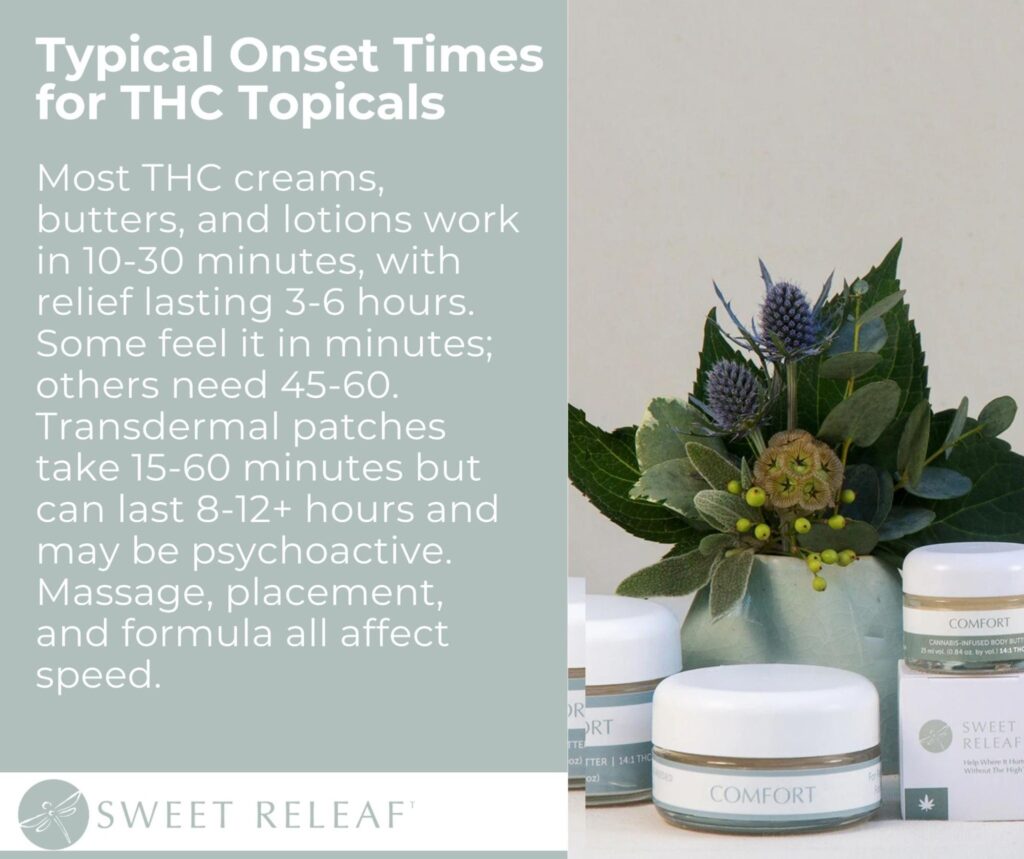
This is often when people wonder how fast it will work and how long should relief last? With a properly formulated high-THC topical, noticeable relief starts within 30 minutes and commonly ranges from three to six hours depending on the severity of strain and the depth of tissue involved.
During injury recovery, once swelling has stabilized and the skin is intact, consistent localized use can support comfort while tissue rebuilds. Reapplication every four to six hours is typical for acute situations.
Long-Term Support
Chronic arthritis and aging joints benefit from steady use rather than sporadic application. Applying a topical once and waiting for dramatic change rarely produces lasting improvement. Daily use allows cannabinoids to repeatedly interact with receptors involved in inflammatory modulation.
Consistent inflammation management often means applying in the morning and again later in the day. Many people layer a topical with gentle massage to improve joint mobility and encourage synovial fluid movement.
This combination supports both mechanical and biochemical relief.
Daily vs Nighttime Use
Morning application supports mobility before work, exercise, or household tasks. A small amount applied to knees, hands, or shoulders can ease stiffness and make movement smoother.
Pre-activity use helps prepare tissues for load. Evening application serves a different purpose. It allows tight areas to soften during rest and can reduce stiffness that builds throughout the day.
Relief has a natural arc. Reapply when sensation begins to return rather than waiting for full discomfort to reestablish itself. Consistency creates steadier results.
Cannabis Topicals Offer A Practical Way Forward
Cannabis creams and lotions are tools. They support movement, soften tension, and give people another option when daily life starts to feel smaller because of pain.
The right topical will feel steady and reliable, yet relief remains personal. Your joints, your activity level, and your history all shape how your body responds.
When you try a new cannabis cream or lotion, don’t rush into conclusions. Pay attention to how your tissues respond over several days rather than judging from a single use.
If you are curious about what a high-THC, full-spectrum topical can do, you should look no further than the Sweet Releaf collection. While you can’t order directly from us, California residents can easily find nearby licensed retailers through our locations page.