
Topical cannabis products containing THC and/or CBD have shown anti-inflammatory and analgesic effects in a range of studies. THC-containing products are associated with higher self-reported pain relief than CBD alone. Topicals act locally and are non-psychoactive.
Real Relief Without the Mental Fog
Let’s start here: arthritis pain is exhausting. It’s the stiff hands in the morning. The knee that argues every time you stand up. The shoulder that reminds you of itself when you reach for a coffee mug.
And when you start looking into cannabis for relief, it gets confusing fast.
The research is still developing. Some studies show reduced inflammation and improved pain scores. Others say we need larger trials.
On top of that, results swing wildly depending on potency, formulation, and how the product is delivered. A weak hemp lotion from a drugstore shelf is a very different animal than a high-THC, full-spectrum topical built specifically for joint pain.
Here’s the honest answer: when they’re formulated correctly, THC-forward topicals can provide meaningful, localized arthritis relief without altering your headspace.
Why people are turning to them:
- They don’t get you high when applied to the skin
- They work right where you rub them in
- THC and other cannabinoids interact with receptors tied to inflammation
- There’s no liver or stomach strain like you get with daily NSAIDs
- Many people find they rely less on opioids and heavy prescriptions
Sweet Releaf started in a grandmother’s kitchen in Marin County. It was built to solve real pain inside one family before it ever became a business. Today it’s still family-owned, still California-grown in spirit, and focused on high-grade, full-spectrum THC topicals that deliver relief without mental fog.
Next, we’ll dig into why arthritis pain is so stubborn, what science actually says about cannabis and inflammation, why topicals behave differently than edibles, and how to choose something that actually matches the promise printed on the label.
Why Arthritis Pain Is Like No Other
Arthritis pain has a personality, and it’s not a nice one. It shifts. It lingers. It wakes you up at night and then dares you to grip a steering wheel in the morning. People often describe it as “deep” or “gnawing,” but that barely captures what is happening beneath the surface.
It’s Not “Just Joint Pain”
A healthy joint is a carefully balanced system. Cartilage cushions movement. Synovial fluid lubricates. Immune cells stand guard without causing chaos. In arthritis, that balance unravels.
Inflammation builds inside the synovial lining, increasing pressure within the joint capsule. Cartilage begins to thin or erode, reducing shock absorption. In rheumatoid and psoriatic arthritis, the immune system itself drives the attack, releasing inflammatory cytokines that amplify tissue damage.
The surrounding muscles tighten in response, trying to stabilize an irritated joint. That tension adds another layer of discomfort. Sleep often suffers, and poor sleep raises pain sensitivity the next day. It becomes a loop.
At some point many people think, “Why does nothing seem to touch this pain?” The answer lies in how many systems are involved at once.
Mainstream Treatment Options and Their Tradeoffs
Conventional medicine offers several paths, each with strengths and limits:
- NSAIDs such as ibuprofen and naproxen reduce inflammation but can irritate the stomach lining and increase cardiovascular risk with long-term use.
- Acetaminophen may dull pain signals yet places strain on the liver when used frequently.
- Steroids can quiet inflammation quickly, though repeated use carries metabolic and bone-related consequences.
- DMARDs and biologics target immune pathways and may slow disease progression, but they do not always provide immediate pain relief.
- Opioids blunt pain perception while introducing serious risks of dependence and cognitive impairment.
When standard tools bring relief at a cost that feels too high, people begin searching for something that works with the body rather than overwhelming it.
Cannabis and Arthritis: A Delicate Link
Cannabis has been used for pain for centuries, yet modern medicine is still sorting out how and when it fits into arthritis care. The conversation has moved beyond cultural debate and into labs, rheumatology conferences, and patient surveys.
The picture that emerges is nuanced, but it is far from empty.
What Research Tells Us So Far
Preclinical research offers some of the clearest signals. In animal models of arthritis, cannabinoids have demonstrated measurable anti-inflammatory and analgesic effects. A 2016 study found that transdermal CBD reduced joint swelling, decreased inflammatory markers, and improved pain-related behaviors in rats with induced arthritis.
Other laboratory studies have shown that both THC and CBD can reduce cytokines such as TNF-alpha and interferon gamma, which are central players in inflammatory joint disease.
Human data are more modest but still notable. A randomized controlled trial of Sativex, a balanced THC and CBD spray, showed improvements in pain on movement and sleep quality in patients with rheumatoid arthritis.
Survey data presented at the American College of Rheumatology in 2023 reported that patients using THC-containing cannabis products were significantly more likely to describe their pain relief as effective compared to those using CBD-only products.
Large-scale, long-term clinical trials unfortunately remain limited at this stage. Formulations vary widely in potency and delivery, which makes broad conclusions difficult. Still, the consistency of anti-inflammatory signals and patient-reported relief has kept cannabis firmly in the arthritis conversation.
CBD vs. THC: Best When Working Together
CBD is non-intoxicating and has documented anti-inflammatory properties. Many patients appreciate its gentle profile. Real-world reports, however, show mixed results when CBD is used alone for moderate to severe joint pain.
THC interacts with both CB1 and CB2 receptors. CB2 receptors are densely involved in immune and inflammatory responses. THC has also been shown in preclinical studies to engage endogenous opioid pathways, which may explain stronger reported pain reduction in some users.

When combined, CBD and THC appear to influence multiple pain pathways at once. Balanced or THC-forward formulations often outperform low-dose isolates in patient reports. The placebo question comes up frequently. Yet across surveys and observational studies, higher potency products with thoughtful carrier systems consistently correlate with stronger outcomes.
The next piece of the puzzle is delivery. How cannabis enters the body changes how it behaves.
Why Topicals Are Different from Your Grandma’s Cannabis
When people hear “THC,” they immediately picture something that changes perception. That association creates hesitation, especially for adults managing arthritis who still need to think clearly, drive, or show up at work.
Topicals operate in a very different lane, and that distinction is where much of their value lies.
Localized Relief Without the High
Topical cannabinoids interact primarily with CB2 receptors in the skin, fascia, and peripheral tissues. These receptors play a role in inflammatory signaling and immune modulation. When a THC-forward cream is applied to the skin in a non-transdermal formulation, the cannabinoids largely remain in local tissue rather than entering systemic circulation.
That’s why people who use properly formulated THC topicals do not experience psychoactive effects. The compound is active in the joint and surrounding tissue without meaningfully engaging the brain.
Many patients initially worry that applying THC will make them feel altered or jeopardize a workplace drug policy. With standard topicals that are not engineered for bloodstream delivery, those concerns are largely unfounded. People routinely apply them in the morning before typing, teaching, lifting, or driving.
The relief is targeted because the activity stays local.
Salve vs. Emulsion: Different Levels of Smooth
Earlier generations of cannabis topicals were often oil-and-wax salves. They can provide some benefit, but their structure tends to sit on the skin’s surface. Absorption is slower, and the residue can feel heavy. That sensation alone leads many people to abandon consistent use.
An emulsion blends oil and water into a stable matrix, allowing cannabinoids to move more effectively through the outer skin layers. The difference shows up in how quickly the product settles in and how the skin feels afterward. A well-formulated emulsion absorbs cleanly, without leaving a thick film behind.
Texture influences compliance more than most brands admit. If a cream smells overpowering or leaves hands greasy, people stop reaching for it. Consistent application, combined with thorough massage, improves circulation and enhances tissue penetration.
In practice, careful rubbing often amplifies the overall effect.
Why Topicals Make Sense for Arthritis
Arthritis frequently affects joints that are relatively accessible to topical therapy, such as fingers, knees, wrists, and shoulders. In these areas, inflammation and stiffness sit close enough to the surface that localized cannabinoid activity can make a practical difference.
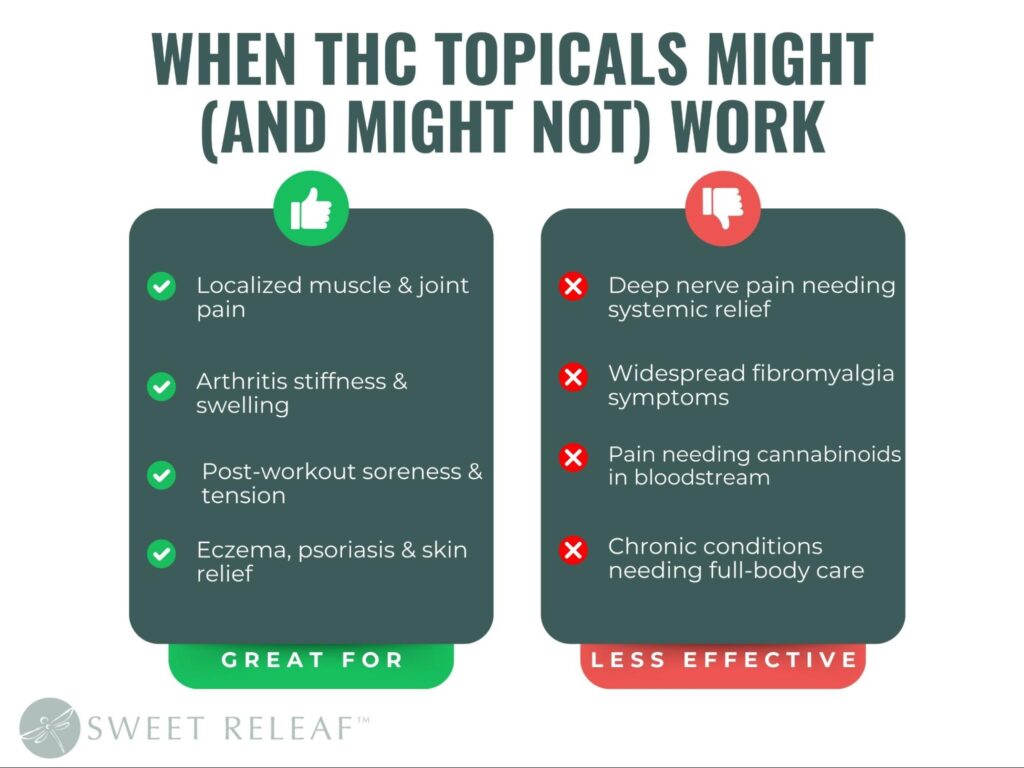
Relief from a high-potency topical typically lasts several hours, often in the range of three to six depending on severity and activity level. For chronic arthritis, most people find that applying two to three times daily maintains steady support.
That rhythm fits naturally into morning routines and evening wind-down without disrupting cognition or daily responsibilities.
Finding a Topical That Actually Works
By the time most people start looking at cannabis topicals for arthritis, they have already tried a few things that disappointed them. A small jar from a health store. A hemp cream a friend recommended. Something with a long ingredient list and very little effect.
At that point the reaction is predictable. “I tried CBD and it did nothing.” Closely followed by, “I don’t want to waste money again.”
That frustration usually has less to do with cannabis itself and more to do with formulation.
Potency Is Critical
In real-world conversations, especially in patient communities, a clear pattern shows up. Lower-potency products often provide minimal relief for moderate to severe arthritis.
Once total cannabinoid content rises into a higher range, reported outcomes improve. That difference is rarely explained on packaging, but it matters.
THC-forward formulations consistently receive stronger pain relief reports than CBD-only creams. That aligns with survey data showing higher perceived effectiveness when THC is included. Many hemp-based CBD topicals rely on isolate rather than full-spectrum extracts, and they often use simple carrier oils that limit tissue penetration.
The result is a product that smells promising and feels moisturizing but fails to meaningfully calm inflammation in a stubborn joint.
For arthritis, potency and carrier system are not minor details. They are the difference between marginal comfort and measurable change.
Why Sweet Releaf Is Different
Sweet Releaf approaches topical cannabis with a functional mindset. Our products are high-THC and full-spectrum, meaning they preserve the natural profile of cannabinoids and plant compounds instead of relying on stripped-down isolates.
We use raw trichomes rather than distillate-heavy shortcuts, and the emulsified base improves penetration into joint-adjacent tissue.
The formulations are non-psychoactive, family-developed, and refined over years of feedback from people living with chronic pain, including arthritis, post-surgical recovery, and age-related joint stiffness.
Ingredient transparency and consistency are part of the culture for us, not an afterthought.
Sweet Releaf Products Ideal for Arthritic Joints
- Comfort+ Extra Strength Body Butter
This high-THC, full-spectrum emulsion is built for daily joint management. The body butter texture allows for thorough massage into hands, knees, and wrists where stiffness builds throughout the day. It is particularly well suited for chronic osteoarthritis and for supporting comfort during rheumatoid flare periods.

2. Comfort Cools Roll-On
Designed for portability, this roll-on combines a cooling Ayurvedic blend with fast-absorbing cannabinoids. It works well for post-activity inflammation or mid-day flare-ups when a heavier cream feels excessive. The finish is light, the scent is balanced, and it can be applied discreetly before work or during a busy afternoon.

Relief Is Within Your Reach
Arthritis quietly reshapes daily life. It changes how you open jars, climb stairs, type, garden, sleep. Over time, many people start believing that discomfort is simply the cost of staying active. It doesn’t have to be that way.
Relief does not need to be associated with sedation or mental haze. You do not have to choose between easing inflammation and staying sharp. Properly formulated THC topicals work locally, supporting irritated joints while leaving your head clear and your day intact.
If you’re curious what a high-THC, non-psychoactive topical can do, take a closer look at Sweet Releaf’s products. Help can come from unexpected places, and we hope you will find it in your local California dispensary carrying our topicals.