Cannabis in Ayurvedic medicine is a traditionally used herb known for balancing doshas, easing pain, and supporting digestion when used correctly.
While ancient texts emphasize careful preparation and moderation, modern applications, like non-psychoactive topicals from brands like Sweet Releaf, offer targeted relief without altering mental clarity.
Cannabis In Ayurveda: More Than Just A Healing Herb

Ayurveda, at its core, is a system built on one simple idea: your body is always trying to find balance. When something feels off, pain, inflammation, poor sleep, it’s not random. It’s communication.
Cannabis has a place in that conversation, and it’s not new.
In Ayurvedic texts, cannabis is referred to as Vijaya, often translated as “the victorious one.” You’ll also see names like Bhanga or Siddhi, which hint at how deeply embedded this plant is in India’s medicinal and cultural history.
The Two Sides Of Cannabis
Cannabis in Ayurveda has always carried two roles at once.
On one side, it’s therapeutic. It’s been used for:
- Pain and inflammation
- Digestive issues like nausea or low appetite
- Stress and nervous system imbalance
On the other side, it has a spiritual and ritual context. Think meditation practices, seasonal festivals like Holi, or stories tied to Lord Shiva. That part matters, not because you need to follow those traditions, but because it shows how cannabis was respected, not consumed casually.
That’s a big difference from how most people encounter it today.
How This Differs From Modern Cannabis Use
Most modern cannabis use starts with the effect: What will this make me feel?
Ayurveda starts with a different question: What does your body need, and how do we deliver it without creating new problems?
Cannabis wasn’t:
- Smoked casually
- Taken daily without thought
- Used in isolation
Instead, it was:
- Prepared carefully (often infused into ghee or combined with other herbs)
- Dosed intentionally
- Matched to the individual’s constitution (dosha)
Ayurveda doesn’t treat cannabis as universally “good.” It treats it as powerful, which means it can help or harm depending on how it’s used.
Not Just Another Herb
In Ayurvedic medicine, cannabis sits in a different category than your everyday herbs like turmeric or ashwagandha.
It’s considered:
- More potent
- More complex
- And in many cases, something that requires guidance or supervision
Some texts even treat it as a semi-controlled substance, not because it’s bad, but because it’s easy to misuse.
And if you’ve ever had a bad experience with cannabis, or tried something that left you foggy instead of better, you’ve already felt that truth firsthand.
The Ayurvedic Logic Behind Cannabis Effects
Cannabis doesn’t act randomly in the body, it follows a pattern. Ayurveda breaks that pattern down into taste, energy, and effect, giving us a clearer way to understand why it relieves pain for some and creates imbalance for others.
Once you see that logic, the experience starts to make sense.
How Cannabis Behaves In The Body
Cannabis follows a predictable pattern:
- Rasa (taste): bitter and pungent
- Virya (energy): heating
- Vipaka (post-digestive effect): pungent
- Qualities (guna): light and dry
That combination explains a lot.
Bitter and pungent qualities cut through stagnation, heat drives circulation, and the light, dry nature reduces heaviness, but can also deplete the system if pushed too far.
This is why cannabis can feel like relief in one moment, and like too much in another. It’s not inconsistent. It’s just potent.
How It Affects You (Doshas & Balance)
Where Ayurveda gets practical is in how cannabis interacts with your system. It’s not one-size-fits-all, it depends on your constitution.
- Vata (air/nervous system): can be calmed
→ helpful for pain, tension, overstimulation - Kapha (earth/water): can be reduced
→ useful for inflammation, sluggishness, congestion - Pitta (fire): can be aggravated
→ especially with overuse, leading to heat, irritability, burnout
So when someone says, “Cannabis works great for me,” what they’re really saying is: it’s working with their body, not against it.
But this is where people get tripped up.
Cannabis can reduce pain, improve appetite, and calm the nervous system, but push it too far, and it flips. You start seeing mental fog instead of clarity, lethargy instead of relief, and digestive slowdown instead of support.
In Ayurvedic terms, that’s when Agni, your digestive fire, starts to weaken.
And once that happens, everything becomes harder to regulate. We’ve seen it firsthand, people chasing more relief, when what they actually need is to bring their system back into balance.
What Does Ayurvedic Cannabis Actually Treat?
If you strip away the mythology and the modern hype, Ayurveda looks at cannabis the same way it looks at any strong plant: Where does it actually help the body return to balance?
And the answer is pretty consistent across centuries, certain patterns show up again and again.
Pain & Inflammation
This is where cannabis earns its reputation. Ayurvedic practitioners have long used it for:
- Arthritis and joint pain
- Muscle soreness and stiffness
- Chronic inflammatory conditions
From our perspective, pain is rarely just physical. It’s the nervous system holding onto something, tension, inflammation, overuse.
Cannabis works here because it speaks to both sides:
- It calms the nervous system
- It reduces inflammation locally or systemically
That combination is why people feel relief so quickly when it actually works.
But the way it’s delivered matters.
Digestive Support
This surprises people, but Ayurveda has always linked cannabis to digestion.
Used correctly, it can:
- Stimulate appetite
- Help with nausea and vomiting
- Support sluggish digestion or gut imbalance
In Ayurvedic terms, it can rekindle Agni, your digestive fire.
But push it too far, and it flips. Overuse can:
- Slow digestion
- Create heaviness
- Lead to that familiar feeling of “I ate, but I don’t feel right”
That’s not the plant failing. That’s dosage and context being off.
Mental & Nervous System Support
Cannabis has a long history of being used for:
- Stress and anxiety
- Sleep issues
- Mental restlessness
And yes, it can calm things down. But this is where we’ve seen the most misunderstanding. There’s a difference between:
- Calming the system
- And dampening it
Short-term, cannabis can take the edge off. Long-term, especially with regular internal use, it can start to flatten the system, less anxiety, but also less clarity, less motivation.
That’s why Ayurveda always pairs this use with caution.
Respiratory & Other Uses
Historically, cannabis has also been used for:
- Asthma and breathing issues
- Cough and congestion (especially Kapha-related)
And you’ll find references to:
- Reproductive health
- Neurological conditions
But if I’m being honest, a lot of those mentions are broad. The strongest, most consistent applications always come back to pain, inflammation, and nervous system balance.
Everything else depends heavily on how it’s prepared and who’s using it.
A Modern Shift: Why Topical Cannabis Aligns With Ayurvedic Principles
If you look at Ayurveda through a practical lens, it’s not about tradition for tradition’s sake. It’s about outcomes.
- Treat the problem where it lives
- Avoid creating new imbalances
- Use the least invasive method that still works
That’s exactly why topical cannabis makes so much sense.
Targeted Relief Without Systemic Fallout
Instead of sending cannabinoids through your digestive system, or into your bloodstream, topicals:
- Deliver relief directly to the affected area
- Stay localized
- Avoid the mental and digestive side effects that come with ingestion
From an Ayurvedic perspective, that’s elegant.
You’re not:
- Overstimulating Agni
- Aggravating Pitta
- Or dulling the mind
You’re working with the body, not pushing it.
The Skin As A Therapeutic Gateway
We don’t always think of skin as a pathway for healing, but it is.
Your skin is rich with receptors, especially CB2 receptors, which interact directly with cannabinoids like THC. When applied topically:
- You’re tapping into that local receptor network
- Reducing inflammation at the source
- Calming the tissue without affecting your mental state
It’s a very different experience from ingesting cannabis.
How Sweet Releaf Combines Ayurveda and Cannabis for Pain Relief
When we started working with cannabis, it wasn’t about building a brand. It was about solving a real problem, pain that wasn’t being handled well without tradeoffs.
Ayurveda gave us the framework, and cannabis gave us a tool worth refining.
The challenge was making them work together in a way that actually holds up in real life. Not theory, something you can use and feel the difference without compromising the rest of your day.
Ayurvedic Inspiration in Formulation

Our roll-ons are probably the clearest example of this.
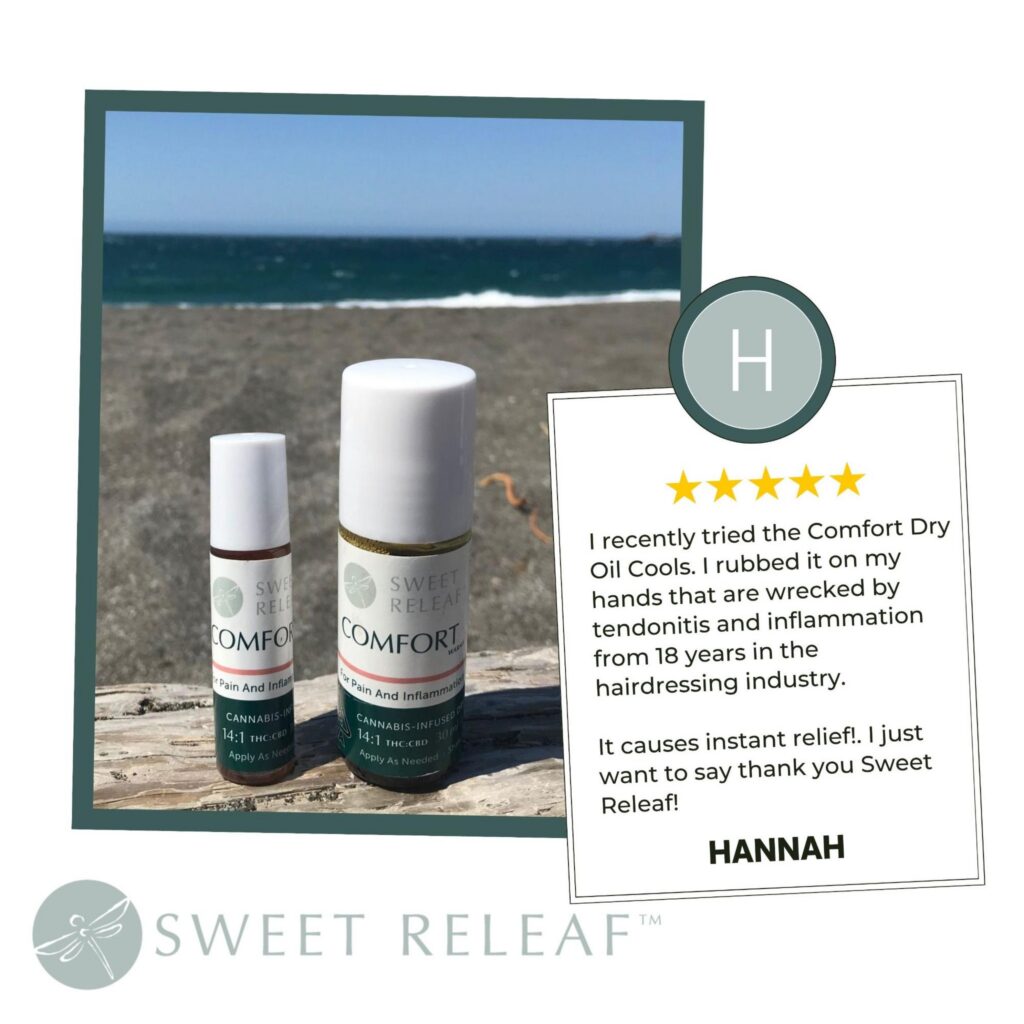
We didn’t just add essential oils for scent, we built them around Ayurvedic energetics: warm formulas for circulation and deeper muscle relief, and cool formulas for calming inflammation and heat.
That warm/cool distinction comes straight out of Ayurvedic thinking, how the body responds to energy and balance.
Instead of forcing one effect, you match the formula to what your body is actually dealing with.
Comfort Warms Dry Oil
Comfort Warms leans into deeper, earthy notes, think wintergreen and grounding botanicals that help increase circulation and loosen tissue that’s not moving well.
It’s not about heat for the sake of sensation. It’s about creating movement where things have gotten stuck, especially in chronic tension or overworked muscles.
Comfort Cools Dry Oil
On the other side, Comfort Cools is built for inflammation, heat, and overstimulation. The profile is lighter, more citrus-forward, and designed to calm things down rather than fire them up.
This is where Ayurveda really shines, recognizing that not all pain needs the same approach. Sometimes the body doesn’t need more stimulation. It needs to cool off and settle.
Why Delivery Method Matters More Than Most People Think
Most cannabis products fail for a simple reason, they don’t get where they need to go. That’s why we focused on emulsions instead of basic oil-based salves.
Our body butters combine oil and water, allowing them to penetrate deeper and absorb quickly without leaving a greasy layer. With aloe vera as a base, cannabinoids are carried more effectively through the skin barrier where they can actually do their job.
We also use whole-plant, full-spectrum THC. THC is the primary driver of pain relief, and the plant works better as a system than in isolated parts. When people say cannabis didn’t work for them, it’s often the formulation, not the plant.
Non-Psychoactive Relief That Still Works
This is the part people don’t expect, you can use a high-THC topical and not get high. No fog, no mental shift, just localized relief where you apply it.
That answers the real concerns people have: whether it will affect their clarity, their work, or their ability to function. It doesn’t. You’re not trading one problem for another.
You’re just applying it where it hurts, and letting your body respond the way it’s designed to.
A More Grounded Way To Use Cannabis
If you zoom out, cannabis in Ayurveda was never about escape. It was about restoring function, helping the body move without pain, digest without discomfort, and sleep without disruption.
That was always the goal.
Somewhere along the way, the focus shifted toward altering the mind instead of supporting the body.
But it doesn’t have to stay that way. If you’re dealing with pain, the better question isn’t “Should I use cannabis?”, it’s “How do I use it without creating new problems?”
That’s where the right approach makes all the difference.
Starting with a well-made topical, like Sweet Releaf’s body butters or Ayurvedic roll-ons, keeps the benefits grounded where you need them most: your body, not your head.