THC tends to deliver stronger relief for inflammation-related pain, while CBD offers milder anti-inflammatory support without a high.
The most effective approach often combines both, but potency and formulation matter.
Sweet Releaf’s high-THC topicals are designed to deliver targeted relief without intoxication, especially when CBD alone falls short.
Why Inflammation Is So Stubborn (And What Actually Helps)
If you’ve ever woken up stiff for no clear reason or carried a deep, nagging ache through the day, you’ve felt inflammation. Sometimes it’s subtle, other times it takes over.
At first, it’s your body trying to protect and repair, but when it lingers, it becomes something else entirely.
Chronic inflammation sticks around long after the injury fades. It shows up as arthritis, stubborn joint pain, or unpredictable flare-ups that interrupt daily life. Most people turn to over-the-counter meds or prescriptions, but over time, those fixes can bring their own problems.
That’s where cannabis starts to get attention.
It works with the body’s endocannabinoid system, something we’re already wired with, to help regulate pain and inflammation more naturally.
Which leads to the real question: when it comes to inflammation, is CBD or THC actually better?
Inside The Body: How Cannabis Helps Quiet Inflammation

Inflammation doesn’t just sit on the surface, it’s part of a deeper conversation happening inside your body.
Cannabis works by tapping into that system, helping regulate how inflammation starts, lingers, and resolves.
Instead of masking symptoms, it interacts with built-in pathways designed to restore balance where things feel stuck.
The Endocannabinoid System
I like to think of the endocannabinoid system as a set of switches your body already knows how to use, you just need the right keys. Two main receptors are involved:
- CB1 receptors live mostly in the brain and nervous system (this is where THC’s “high” comes from)
- CB2 receptors are found throughout the body, especially in immune cells and inflamed tissue
When it comes to inflammation, CB2 is where the real work happens. It helps regulate how your body responds, how strong the reaction is, how long it lasts, and how it resolves.
With a well-formulated topical, cannabinoids interact locally with these receptors, meaning you can target inflammation right at the source without affecting your mind.
Why “Pain Relief” And “Inflammation Relief” Aren’t The Same
Pain and inflammation are related, but they’re not the same thing.
- Inflammation is physical, swelling, immune activity, tissue irritation
- Pain is perceptual, how your brain interprets what’s happening
CBD and THC influence both, but in different ways. CBD tends to calm inflammatory signals, while THC more strongly affects how pain is felt and processed.
That’s why THC can feel more effective, even if the inflammation hasn’t fully resolved, it changes your experience of it.
CBD For Inflammation: The Good And The Limitations
CBD has become the go-to starting point for inflammation: gentle, accessible, and easy to use. For mild discomfort, it can take the edge off without affecting your head.
But when inflammation runs deeper or sticks around longer, many people find its effects too subtle to truly make a difference.
How CBD Works
CBD has built its reputation on being gentle, and for some people, that’s exactly what’s needed.
It interacts with the body in a way that may help dial down inflammatory signaling, more like a nudge than a push. That’s why it’s often used for general soreness, mild stiffness, or low-level inflammation.
It’s also non-psychoactive, which makes it easy to use anytime. No mental fog, no shift in perception, just a subtle effect that fits into daily life.
On paper, it checks a lot of boxes, which is why many people start here.
Where CBD Falls Short
A lot of people try CBD and feel nothing. Not subtle relief, just no change at all.
And most of the time, it’s not the person, it’s the product. The usual issues include:
- Low potency – not enough cannabinoids to make a real impact
- Hemp-only limitations – missing THC reduces effectiveness
- Poor formulations – products that don’t penetrate where it matters
What many people experience isn’t CBD failing, it’s an underpowered formula that never had a chance.
THC For Inflammation: Why It Often Works Better For Real Pain
THC tends to stand out when inflammation turns into real, limiting pain. It doesn’t just quiet the underlying issue, it changes how your body experiences it.
For many people, that means more noticeable relief, easier movement, and less mental focus on discomfort, especially when lighter options haven’t done enough.
How THC Works Differently
If CBD is a gentle nudge, THC is more direct.
It interacts with both inflammation pathways and how your body processes pain, engaging CB1 and CB2 receptors at the same time.
That means it can influence both the source of inflammation and how intensely you feel it.
That’s why THC often feels stronger. It doesn’t just quiet inflammation, it changes how loud the signal is.
For many people, that translates into relief you can actually notice, not just hope for.
What THC Is Best For
There’s a clear pattern: when inflammation becomes limiting instead of just annoying, THC tends to step in where CBD falls short.
It’s especially useful for moderate to severe inflammation, chronic joint issues, and lingering post-surgical discomfort.
It’s also where expectations shift. People aren’t comparing THC to nothing, they’re comparing it to years of trying what didn’t work.
And in those cases, THC often stands out as the first thing that truly makes a difference.
What Relief Actually Feels Like
Relief doesn’t always mean the pain disappears. More often, it feels like the volume gets turned down, less sharp, less constant, less intrusive.
People describe muscles relaxing, the body feeling lighter, and the mind no longer fixating on discomfort.
It’s not just physical, it’s a shift in how present the pain feels. In many cases, THC changes both the signal and your relationship to it.
The Catch With THC
THC isn’t perfect, and it’s important to be honest about that. Depending on the dose and format, it can create psychoactive effects, increase anxiety in some users, or feel overwhelming if misused.
Most negative experiences come down to mismatch, too much, the wrong format, or poor timing.
This isn’t about using more THC. It’s about using it in a way that fits your body.
The Part Most People Get Wrong About THC
Topical THC does not get you high.
When properly formulated, it works locally, binding to receptors in the skin and tissue without entering the bloodstream in a meaningful way. That means you get targeted relief exactly where you need it, without affecting your mind or daily function.
For many people, that’s the moment everything clicks.
Why Combining CBD And THC Works Better Than Either Alone
CBD and THC aren’t opposites, they’re better together. When combined, they support each other’s strengths, creating a more balanced and effective response to inflammation. CBD can smooth out THC’s intensity, while THC brings the depth of relief many people are missing, especially when pain has moved beyond mild discomfort.
The Entourage Effect
If you spend enough time working with this plant, you start to realize something: it was never designed to work in isolated parts.
CBD and THC aren’t competitors, they’re collaborators.
When used together, they create what’s often called the entourage effect, but I prefer to think of it as balance. THC brings strength. CBD brings control. One pushes, the other steadies.
- CBD can soften the sharper edges of THC, helping reduce things like anxiety or overstimulation
- THC amplifies the actual relief, especially when inflammation is stubborn or deep
Instead of choosing between subtle and strong, you get a spectrum that can be tuned.
And in real-world use, that combination often lands closer to what people are actually looking for: noticeable relief that still feels manageable.
Why Most Cannabis Topicals Don’t Work (And What’s Different Here)
Most cannabis topicals don’t fail because cannabis doesn’t work. They fail because they’re built to sit on a shelf, not solve a problem.
You apply them, feel a little surface comfort, and then… nothing. The usual issues are simple:
- Low THC content that isn’t strong enough to matter
- Hemp-only CBD formulas missing the punch needed for real inflammation
- Greasy salves that never penetrate deep enough to reach where relief actually happens
That’s where people lose trust, not in cannabis, but in products that never had a real shot.
What Actually Makes A Topical Effective
When a topical does work, it’s because a few key things were done right.
First, it needs enough THC to engage the body, supported by full-spectrum cannabinoids so the plant can work as a whole, not in isolated fragments.
Just as important is how it’s delivered. An emulsion-based body butter absorbs and carries cannabinoids deeper into the tissue, instead of sitting on the surface like a waxy salve.
That difference in penetration is often what separates “I think it’s doing something” from real, noticeable relief.
How Sweet Releaf Approaches Inflammation Relief
Sweet Releaf wasn’t built to follow trends, it was built to solve real pain.
By focusing on high-THC, full-spectrum formulations and deeper-penetrating delivery, these topicals are designed to reach inflammation at its source.
The goal is simple: create something you can feel working, without needing to feel high.
High-THC, Full-Spectrum Formulation
Too many products were built around limits: low THC, isolated CBD, and formulas designed to check boxes instead of solve problems.
So we went the other direction
Sweet Releaf is THC-forward, supported by CBD and the full spectrum of cannabinoids, including THCa. It’s not about trends, it’s about building something strong enough to meet real, persistent inflammation.
Emulsion Body Butters (Why They Work Better)
The other half of the equation is delivery. Most salves sit on the skin, feel greasy, and never reach the tissue where inflammation actually lives.
That’s why we use an emulsion-based body butter.
It absorbs quickly, carries cannabinoids deeper, and avoids that heavy, waxy layer. You’re not just applying something, you’re getting it where it needs to go.
You notice it right away: it goes in fast, doesn’t feel sticky, and starts working beneath the surface.
That difference, real penetration versus surface contact, is what makes it effective.
Where This Actually Shows Up In Your Body
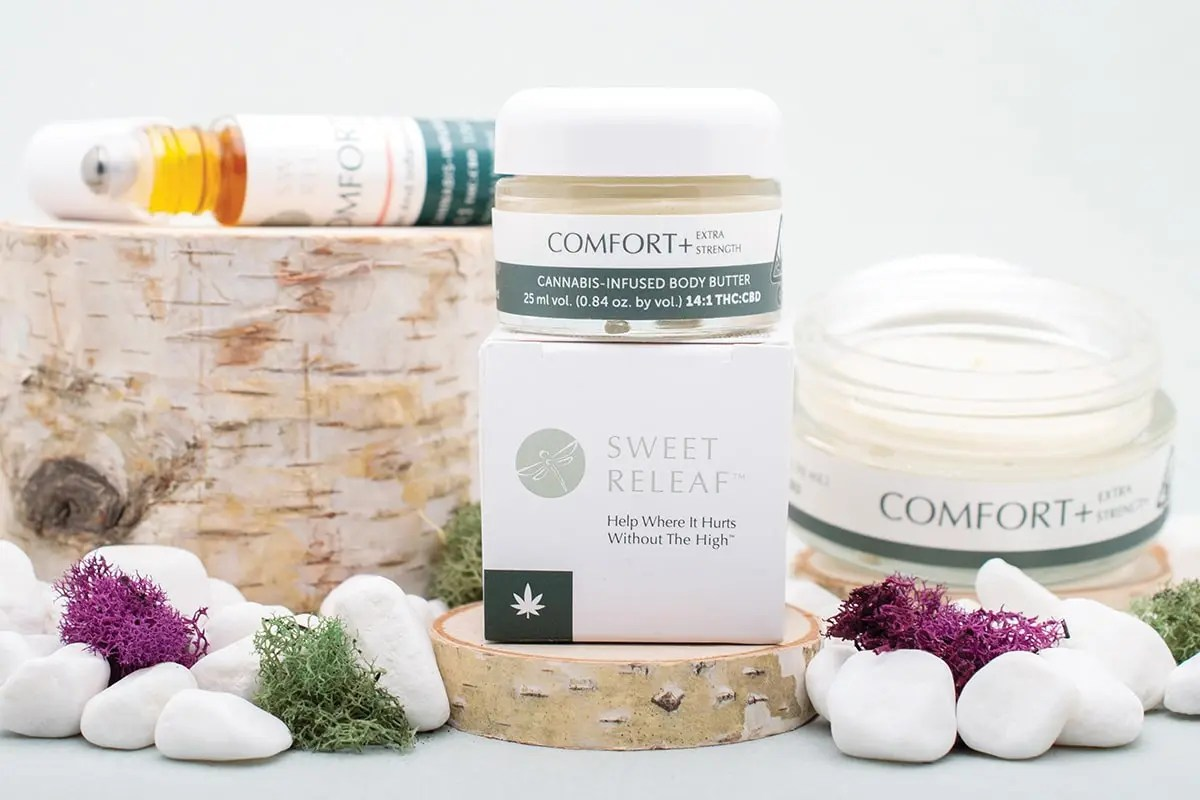
We keep the lineup simple, because the goal isn’t to overwhelm, it’s to match the right level of support to the right situation.
- Comfort Body Butter
This is your daily go-to. For stiffness, soreness, the kind of inflammation that builds up from living your life, gardening, working, carrying, repeating. It’s steady, reliable support. - Comfort+ Extra Strength
When things are more serious, chronic conditions, deeper joint issues, post-surgical recovery, this is where people tend to land. Higher potency, more noticeable impact. - Ayurvedic Roll-Ons (Warm & Cool)
These are targeted tools. The warming formula helps loosen tight, stubborn areas. The cooling one calms and soothes. Easy to apply, especially when you’re on the move.
Each one is built on the same foundation: high-THC, full-spectrum relief that doesn’t rely on getting you high to work.
Finding Relief That You Can Count On

At some point, the question stops being CBD vs THC.
That’s the question you start with, but it’s not the one that gets you results. What actually matters is simpler, and more honest:
- Is there enough strength to make a difference?
- Is the formula built to work with your body, not just sit on the surface?
- Are you using the right method for the kind of inflammation you have?
Those three things will take you further than chasing the “perfect cannabinoid.”
There’s always going to be some trial and error. Bodies change. Pain shifts. What works for your hands might not work for your back. But that doesn’t mean you’re guessing blindly.
It just means you start smarter.
Start with something that has real potency. Something that’s designed to penetrate. Something that meets the problem where it lives, not somewhere upstream or downstream.
From there, your body will tell you the rest.